
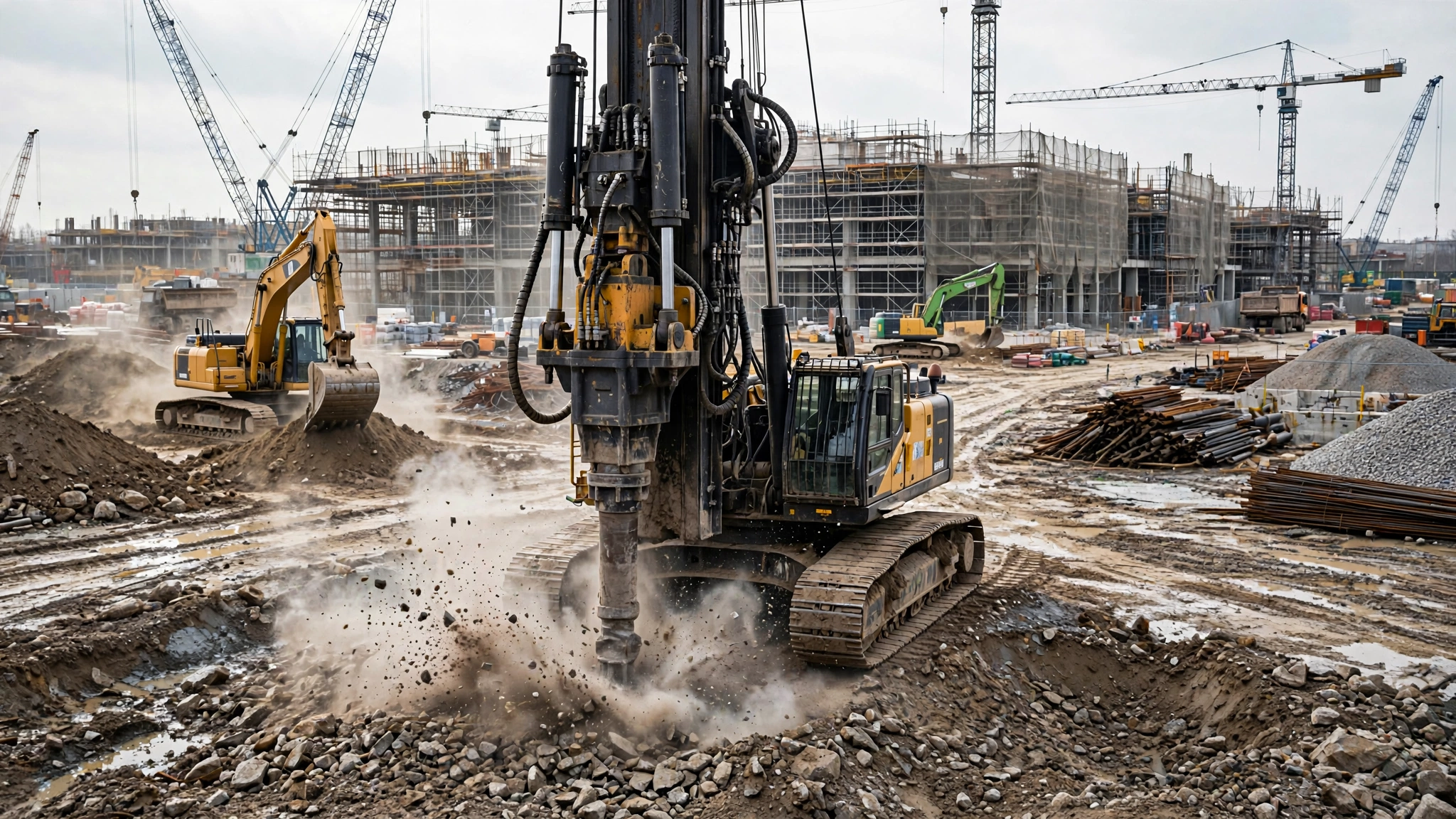
What Is a Pile Driver? The Complete A-to-Z Guide with 44 Must-Know Terms

Table of Contents
If you have ever looked at a towering skyscraper, a massive bridge, or a port crane standing firm against ocean waves, you have witnessed the work of a pile driver. This powerful machine is the unsung hero of the construction world, responsible for creating the deep foundations that keep our largest structures stable and safe.
A pile driver is a heavy construction machine designed to force long, slender columns called piles deep into the ground. These piles transfer the weight of a structure from weak surface soils down to stronger, load-bearing layers of rock or compacted earth. Without this equipment, building on soft soil, wetlands, or coastal areas would be nearly impossible.
In this complete A-to-Z guide, we will cover everything you need to know about this equipment — from its basic components and working principles to different types, soil considerations, and the 44 essential terms every professional must know.
1. What Exactly Is a Pile Driver?
At its most basic level, this machine uses repeated impact or vibration force to drive structural piles into the ground until they reach a load-bearing depth. Think of it like a giant hammer that pounds long steel, concrete, or timber columns into the earth.
This equipment consists of several key components working together:
- Hammer System: The part that delivers the striking force to the pile
- Leads: The vertical guide frame that holds the hammer and pile in alignment
- Ram: The moving weight inside the hammer that strikes the pile
- Winch: The powered drum that raises and lowers the hammer
- Base Machine: The crane or rig that supports and positions the entire system
When the rig operates, it lifts a heavy ram and drops or fires it onto the pile head. This impact energy transfers down the pile shaft, overcoming soil resistance and driving the pile deeper with each blow. The process continues until the pile reaches a dense stratum or achieves the required bearing capacity.
2. Why Do We Need a Pile Driver?
The simple answer is soil conditions. Not all ground is strong enough to support heavy structures. Topsoil, clay, sand, and loose gravel can shift, settle, or wash away over time. A pile driver solves this problem by pushing piles through these weak layers until they hit bedrock or dense, compacted soil that can bear heavy loads.
Here are the primary reasons construction projects rely on this equipment:
- Weak Surface Soils: When the upper soil layers lack strength, piles transfer the structure’s weight to deeper, firmer ground.
- High Water Tables: In coastal or flood-prone areas, the machine can install piles that resist uplift forces from water.
- Heavy Structural Loads: Skyscrapers, bridges, and industrial facilities exert enormous weight that only deep foundations can support.
- Seismic Resistance: Piles driven deep into the ground help buildings withstand earthquake forces by anchoring them firmly.
- Limited Site Access: In tight urban spaces, the rig can install foundations without extensive excavation.
Every major city skyline, every suspension bridge, and every offshore oil platform exists because a pile driver did its job first.
3. Types of Pile Drivers
Not all machines in this category are the same. Different soil conditions, pile materials, and project requirements demand different technologies. There are three main categories to explore in detail.
3.1 Impact Hammers
An impact hammer is the classic pile driver that uses a heavy ram falling onto the pile head. These are the most common and versatile systems on the market.
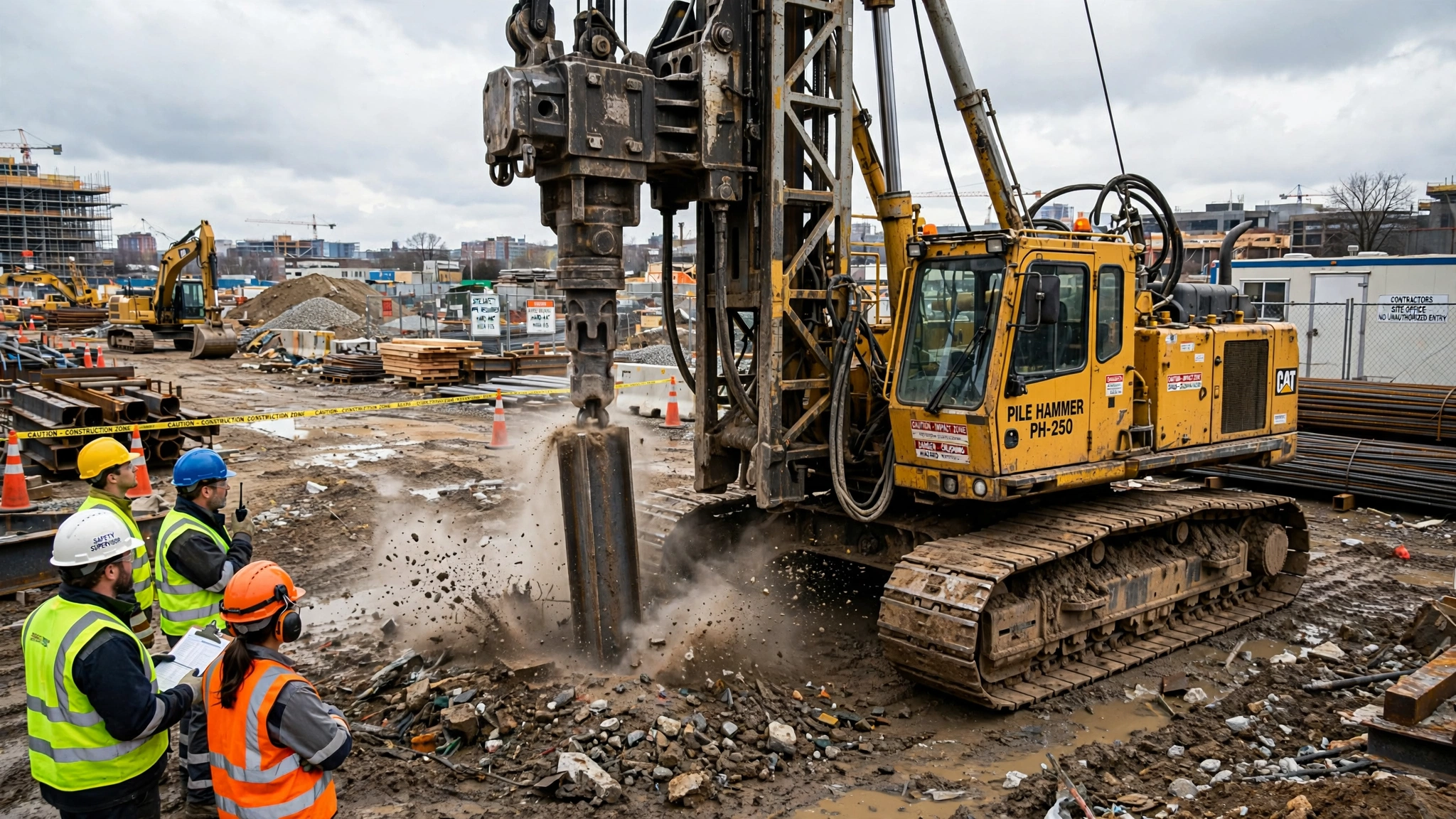
A winch lifts the ram to a specific height, then releases it. The ram falls under gravity or is assisted by hydraulic or diesel pressure, striking the pile cap with tremendous force.
Diesel Hammers: These self-contained units work like a large two-stroke engine. The falling ram compresses fuel-air mixture, and the explosion drives the pile while throwing the ram back up. Simple, powerful, and loud — a classic jobsite favorite.
Hydraulic Hammers: These systems use hydraulic fluid to lift the ram, which then falls under gravity and hydraulic assist. They offer consistent impact energy and quieter operation than diesel units.
Drop Hammers: The simplest design — a weight raised by a winch and released to fall under gravity alone. Slow and largely superseded, but still used on small or remote jobs.
Best For: Proving bearing capacity by blow count, driving piles to refusal on firm strata, and projects where speed and low cost per pile matter most.
Pros: Fast and proven technology, confirms capacity as it drives, works in most soil conditions. Cons: Very loud and high-vibration, restricted near sensitive structures, can damage fragile piles.
3.2 Vibratory Hammers
A vibratory pile driver uses counter-rotating eccentric weights to vibrate the pile at high frequency. This vibration liquefies granular soil around the pile, allowing it to sink with minimal resistance.
The machine clamps onto the pile and vibrates it. The vibrations reduce friction between the pile and surrounding soil, letting the pile slide down under its own weight.
Best For: Driving sheet piles and lightweight piles, sandy and granular soils, and projects requiring low noise and moderate speed.
Pros: Faster and quieter than impact in sand, no loud pounding, can extract piles as well as drive them. Cons: Weak in stiff clay and hard soils, cannot prove bearing capacity by blow count, not suitable for large, heavy piles.
3.3 Rotary Drilling Rigs
While not a traditional pile driver, rotary drilling rigs create bored piles by augering holes and filling them with concrete and steel. This is the quiet, low-vibration alternative to impact driving.
A kelly bar spins an auger that bores into the ground, cutting and lifting spoil up its flights. The hole is then filled with reinforcement and concrete.
Best For: Dense, mixed, or rocky ground, urban sites with noise restrictions, and large-diameter, high-capacity shafts.
Pros: Quiet and near-vibration-free, safe beside existing buildings, handles obstructions and hard layers. Cons: Slower than impact driving, higher cost per pile, cannot prove bearing by blow count.
4. How a Pile Driver Works – The Science Behind the Power
To truly understand this equipment, you need to understand the physics at play. Every time the ram strikes the pile, energy transfers from the machine to the pile and then into the ground.
Ram Weight: Heavier rams deliver more energy per blow. A rig with a 5-ton ram exerts far more force than one with a 1-ton ram.
Stroke Length: The distance the ram travels before impact. Longer stroke means more energy per blow but fewer blows per minute. Diesel and hydraulic hammers let the operator tune stroke to match driving resistance.
Blow Count: The number of hammer blows required to advance a pile a set distance — usually blows per foot or per inch near the end. Rising blow count signals the pile is reaching bearing; it is the operator’s live readout of ground resistance.
Set or Penetration: The permanent movement of the pile per blow. Final set is recorded and fed into dynamic formulas to confirm bearing capacity.
Energy Per Blow: Ram weight × effective stroke. Matching hammer energy to pile and soil is the central sizing decision: too little won’t drive, too much cracks the pile.
The driving cycle: the machine raises the ram to the desired stroke height, the ram is released or fired, it strikes the pile cap or helmet, impact energy travels down the shaft, the pile penetrates the soil by a small amount, the ram resets, and the operator monitors blow count and set to know when to stop.
A skilled operator reads these signals to determine when the pile has reached bearing capacity. Driving too long can damage the pile; stopping too soon means the foundation is unsafe.
5. The 44 Must-Know Pile Driver Terms
Every professional in this field needs to understand the language of the industry. Here are 44 essential terms with clear definitions.
| # | Term | Definition |
|---|---|---|
| 1 | Auger | A helical drilling tool that bores into the ground by rotation |
| 2 | Bearing Capacity | The maximum load a pile can safely carry |
| 3 | Blow Count | The number of hammer blows to advance a pile a set distance |
| 4 | Bored Pile | A pile formed by drilling a hole and filling it with concrete |
| 5 | Casing | A steel tube that supports the walls of a bored hole |
| 6 | Cushion | Replaceable material between the hammer ram and the pile |
| 7 | Diesel Hammer | A self-contained impact hammer using internal combustion |
| 8 | Drift | Unwanted sideways wander of a pile during driving |
| 9 | Drop Hammer | The simplest design using a weight raised by a winch |
| 10 | Dynamic Formula | An equation estimating bearing capacity from hammer energy |
| 11 | End Bearing | Load support from the pile tip resting on a firm layer |
| 12 | Extension Piece | An extension placed between the hammer and pile |
| 13 | Friction Pile | A pile carrying load through skin friction along its shaft |
| 14 | Gates | The guides on the leads that hold the pile and hammer |
| 15 | Hammer Energy | The work delivered per blow in foot-pounds or kilojoules |
| 16 | Hard Driving | Conditions where the pile advances very little per blow |
| 17 | Heave | Upward ground movement caused by driving displacement piles |
| 18 | Helmet | A steel cap fitted over the pile head to distribute blows |
| 19 | Jetting | Pumping high-pressure water to loosen soil ahead of driving |
| 20 | Kelly Bar | The telescoping drive shaft on a rotary drilling rig |
| 21 | Leads | The vertical guide frame holding hammer and pile |
| 22 | Mandrel | A stiff steel core inserted into a thin shell pile |
| 23 | Mast | The tall vertical structure supporting the leads |
| 24 | Overdrilling | Drilling an oversized hole ahead of pile installation |
| 25 | Predrilling | Boring a pilot hole before driving to ease penetration |
| 26 | Ram | The moving weight inside the hammer that strikes the pile |
| 27 | Penetration Rate | How fast a drilling tool advances into the ground |
| 28 | Refusal | The point where a pile stops advancing meaningfully |
| 29 | Rotary Drilling | Forming a pile bore with a rotating auger or drill head |
| 30 | Set | The permanent penetration of a pile per blow |
| 31 | Sheet Piles | Interlocking pile sections forming continuous walls |
| 32 | Skin Friction | The load-bearing grip between pile shaft and soil |
| 33 | Soil Displacement | The soil pushed aside when a solid pile is driven |
| 34 | Spreader Bar | The adjustable arm connecting leads to the crane |
| 35 | Spudding | Repeatedly dropping a spud to punch a starter hole |
| 36 | Stroke | The distance the ram travels before impact |
| 37 | Template | A frame positioning piles at the correct location |
| 38 | Torque | The rotational force a drilling rig applies |
| 39 | Vibratory Hammer | A driver using counter-rotating weights to vibrate piles |
| 40 | Wale | A horizontal member tying sheet piles together |
| 41 | Water Table | The depth below which soil is saturated |
| 42 | Whipping | Lateral flexing of a long pile during driving |
| 43 | Winch | The powered drum raising the hammer and tools |
| 44 | Working Load | The actual service load a pile carries in the finished structure |
6. Soil Types and Your Pile Driver Choice
The soil beneath your project is the single most important factor in choosing the right equipment. Here is how different soils affect your decision.
Sand and Gravel: Best choice is vibratory or impact. Granular soils densify under vibration, making vibratory hammers extremely effective.
Clay and Silt: Best choice is impact or rotary. Cohesive soils resist vibration; impact hammers provide the force needed.
Rock and Hardpan: Best choice is impact or rotary drilling. Only powerful impact or rotary tools can penetrate hard layers.
Mixed or Layered Soil: Best choice is rotary drilling. Boring through varying conditions is more predictable.
Urban or Sensitive Sites: Best choice is rotary or vibratory. Low noise and vibration protect nearby buildings and residents.
For compact urban jobsites where space is tight, crews often pair this rig with smaller support machines. The TYPHON FURY 10 Mini Road Roller is a popular choice for compacting backfill and prepping access paths around a pile driving rig on confined sites.
Your equipment selection determines project cost, timeline, and success rate. Choosing wrong can destroy your budget and schedule.
7. Common Mistakes and How to Avoid Them
Even experienced crews make mistakes with a pile driver. Here are the most common errors.
1. Mismatched Equipment and Soil: Using a vibratory driver in clay or an impact hammer in loose sand wastes time and money. Match the machine to the soil type before you start.
2. Skipping Site Investigation: Failing to identify underground utilities, rock layers, or groundwater levels can cause catastrophic failures. Always survey the site before mobilizing.
3. Incorrect Hammer Sizing: Too small a rig won’t reach bearing; too large will crack concrete piles. Calculate hammer energy requirements carefully.
4. Ignoring Lead Alignment: Misaligned leads cause pile drift, wasted energy, and damaged equipment. Alignment matters more than crews often realize.
5. Neglecting Cushion Maintenance: Worn cushions waste energy and crack piles. Replace them regularly.
6. Overlooking Environmental Regulations: Noise and vibration limits vary by location. Check local rules before operating.
7. Stopping Too Early or Driving Too Long: Monitor blow counts closely. Stop when the pile reaches bearing; don’t overdrive.
8. Safety Tips for Pile Driver Operation
This equipment is powerful and dangerous. Follow these safety guidelines to protect your crew, your equipment, and your project.
- Always wear hard hats, steel-toe boots, ear protection, and high-visibility vests
- Keep unauthorized personnel away from the swing radius
- Inspect cables, cushions, and hydraulic lines daily
- Ensure the leads are properly plumbed before starting
- Communicate clearly between operator and ground crew
- Never stand under a raised ram or suspended pile
- Follow the manufacturer’s operating manual
- Have an emergency stop procedure in place
9. Impact vs. Rotary – When to Use Which
Here is a quick reference to help you decide between the two main methods.
| Factor | Impact Driving | Rotary Drilling |
|---|---|---|
| Soil Type | Drivable soils to firm strata | Dense, mixed, rocky |
| Noise | High | Low |
| Vibration | High | Low |
| Pile Type | Pre-made driven piles | Cast-in-place shafts |
| Bearing Proof | Yes (by blow count) | No (relies on design) |
| Speed | Fast | Slower |
| Cost | Lower per pile | Higher per pile |
| Best For | Open sites, speed, cost | Urban sites, hard ground |
The bottom line: hammer when you can — impact driving is faster, cheaper, and proves bearing as it goes. Bore when you can’t — rotary wins when noise, vibration, obstructions, or very hard ground take hammering off the table.
10. Conclusion – Your Foundation Partner
This equipment is more than just a machine. It is the foundation of modern infrastructure. From the tallest skyscraper to the longest bridge, from offshore platforms to retaining walls, a pile driver makes it possible to build where nature says “no.”
Understanding this machine — its types, operation, soil interactions, and terminology — separates successful contractors from those who struggle. Whether you choose impact, vibratory, or rotary, the right setup for your project will save time, money, and headaches.
Remember: the right equipment is your partner in creating safe, stable, and long-lasting foundations. Treat it with respect, choose the right type for your conditions, and always prioritize safety.
Looking to round out your jobsite fleet? Beyond deep foundation work, many crews also need lifting access equipment on the same site.
Explore TYPHON Machinery’s Scissor Lift range for safe, efficient elevated access alongside your foundation crew.