
Pile Driving Risks: 6 Real Dangers That Show Up on Site

Table of Contents
1. Introduction
Pile Driving Risks are not the dramatic kind shown in safety videos. They are quiet. They creep in during a normal shift, on a job that looked fine on paper.
Ask anyone who has run a rig for years. They will tell the same story about Pile Driving Risks. The dangerous moments are rarely obvious. A hose looks fine until it bursts. The ground seems solid until a pile drops six inches too far. A crew looks sharp until the third straight twelve-hour day.
That is what this piece covers. Not a checklist. Not a lecture. Just the hazards that actually show up, and what separates a job that ends cleanly from one that ends in a report detailing Pile Driving Risks.
Half of managing Pile Driving Risks comes down to noticing. The other half comes down to acting on what got noticed. Most crews manage the first part. The second part is where jobs fall apart.
2. The Ground Does Not Read the Report
The soil report says one thing. The site says another. One of the biggest Pile Driving Risks is trusting old paper over present reality.
Test holes are drilled at intervals. Between those holes is guesswork. Sometimes the guesswork lands close. Sometimes a boulder sits exactly where nobody drilled. A soft pocket waits beside a hard layer. Water sits higher than the dry-season drilling suggested.
What happens next depends on the crew. Some stop. They ask questions. They bring in someone to check. Others keep driving and hope. Hope is not a method to manage Pile Driving Risks.
More testing is not the answer. Testing has limits too. The answer is showing up expecting the ground to disagree with the paperwork. Surprises stop being disasters once they are expected.
Watch the blow count. Not as a number to write down. As a signal. Something changed? Stop. Figure it out. A pile that keeps getting hammered while the crew argues is a pile that will crack. This is how Pile Driving Risks escalate.
There is another angle worth considering. Soil reports age. Ground shifts with seasons. Water tables rise and fall. Nearby excavation compresses layers that used to sit loose. A report from six months ago describes a site that may no longer exist in that form. Treat it as a starting point. Never as a final answer to Pile Driving Risks.
3. Equipment Picks Its Moment
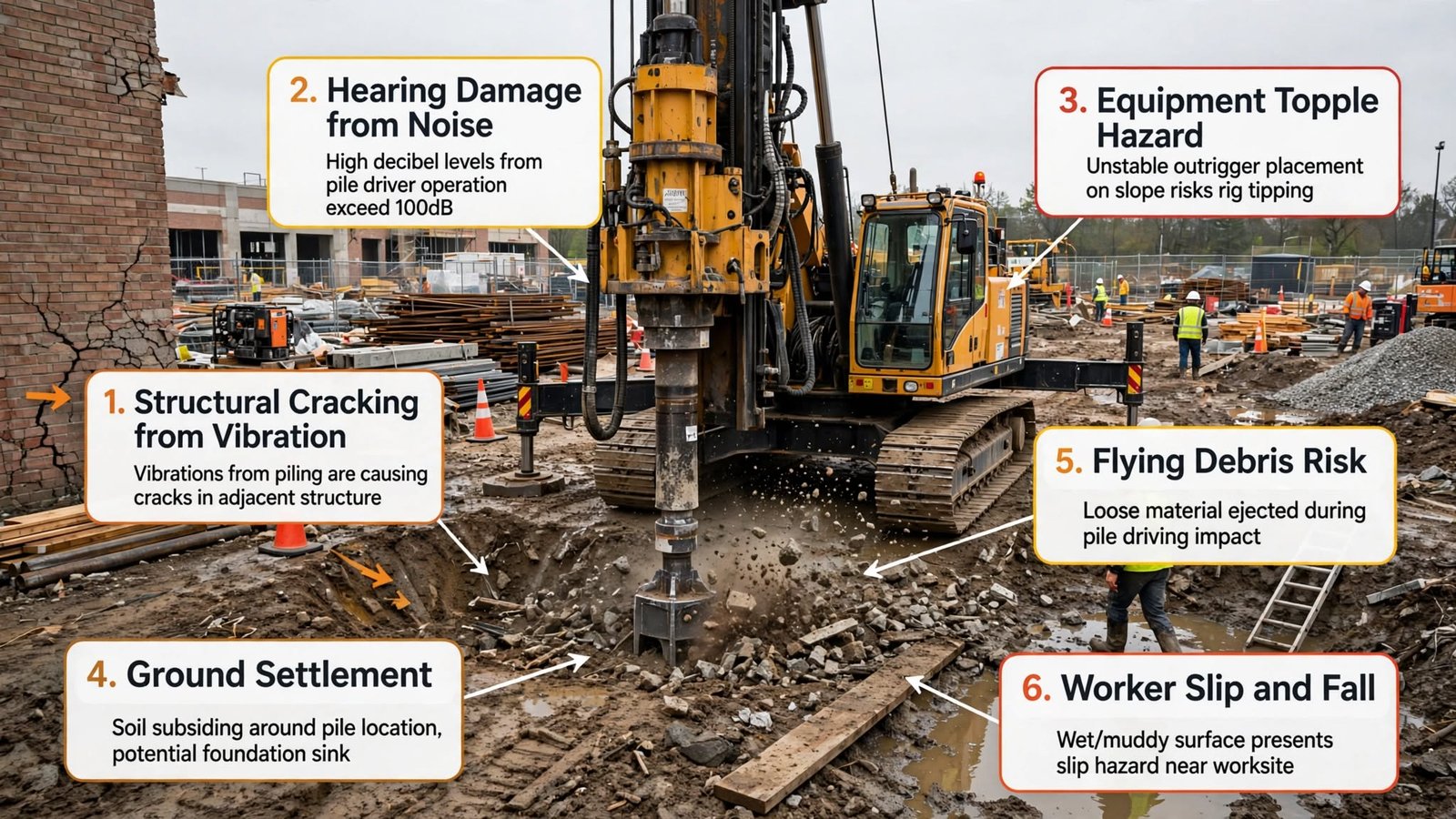
A hammer that fails on a quiet Tuesday costs a few hours. The same hammer failing mid-lift costs a lot more, raising Pile Driving Risks exponentially.
Hydraulic hoses let go. Cables fray. Cushions thin out. None of this is rare. Timing is what turns a repair into an incident.
A burst hose whips. A snapped cable drops tons of steel. A worn cushion sends shock straight into the pile head instead of absorbing it.
The frustrating part is the warning signs usually show up days early. A cable with broken strands. A strange rhythm in the hammer. Heat where there should be none.
Nobody looks. The schedule is tight. Maintenance gets pushed to next week. Next week becomes never. This mindset maximizes Pile Driving Risks.
Simple habits break the cycle. Check before each shift. Replace on schedule. Keep spares on site. A box of cushions costs less than an hour of downtime. That is not an exaggeration.
Spare parts deserve a mention of their own. A crew waiting on a cushion delivery loses an entire shift. A crew with two spares in the toolbox never notices the delay. The cost difference is tiny. The schedule difference is enormous. Every assessment of Pile Driving Risks should include a parts inventory.
4. The Fall Zone Is Not a Suggestion
A pile is heavy. A hammer is heavier. A short fall is enough to make fall zones one of the most critical Pile Driving Risks.
Everyone knows the rule. Nobody stands under a suspended load. Then familiarity sets in. The lift has been done hundreds of times. Someone steps in for a second to check something. That second is the whole story.
The zone moves too. As the rig relocates, the danger area relocates with it. Barriers put up in the morning may guard the wrong patch by afternoon. Nobody updates them.
Enforcement matters more than signage. An operator who stops the job when someone crosses the line needs backup, not eye rolls. The crews that stay safe are the ones where stopping work is acceptable, not embarrassing.
New workers are the highest risk. They want to prove themselves. They move fast. They step close. Pair them with someone experienced for the first few weeks. Pile Driving Risks around new hires drop sharply with proper mentoring.
5. Vibration Travels
Impact driving shakes the ground. That is the point. It is also the problem, creating hidden Pile Driving Risks.
Vibration does not stop at the fence. It moves through soil and into whatever sits nearby. Older buildings. Buried pipes. A neighbour’s extension built in 1972.
Cracks appear weeks later. By then the pile crew is long gone. The claim arrives by post.
Noise is the other half. Hearing damage builds slowly. Nobody notices until the ringing never stops. By then the damage is permanent.
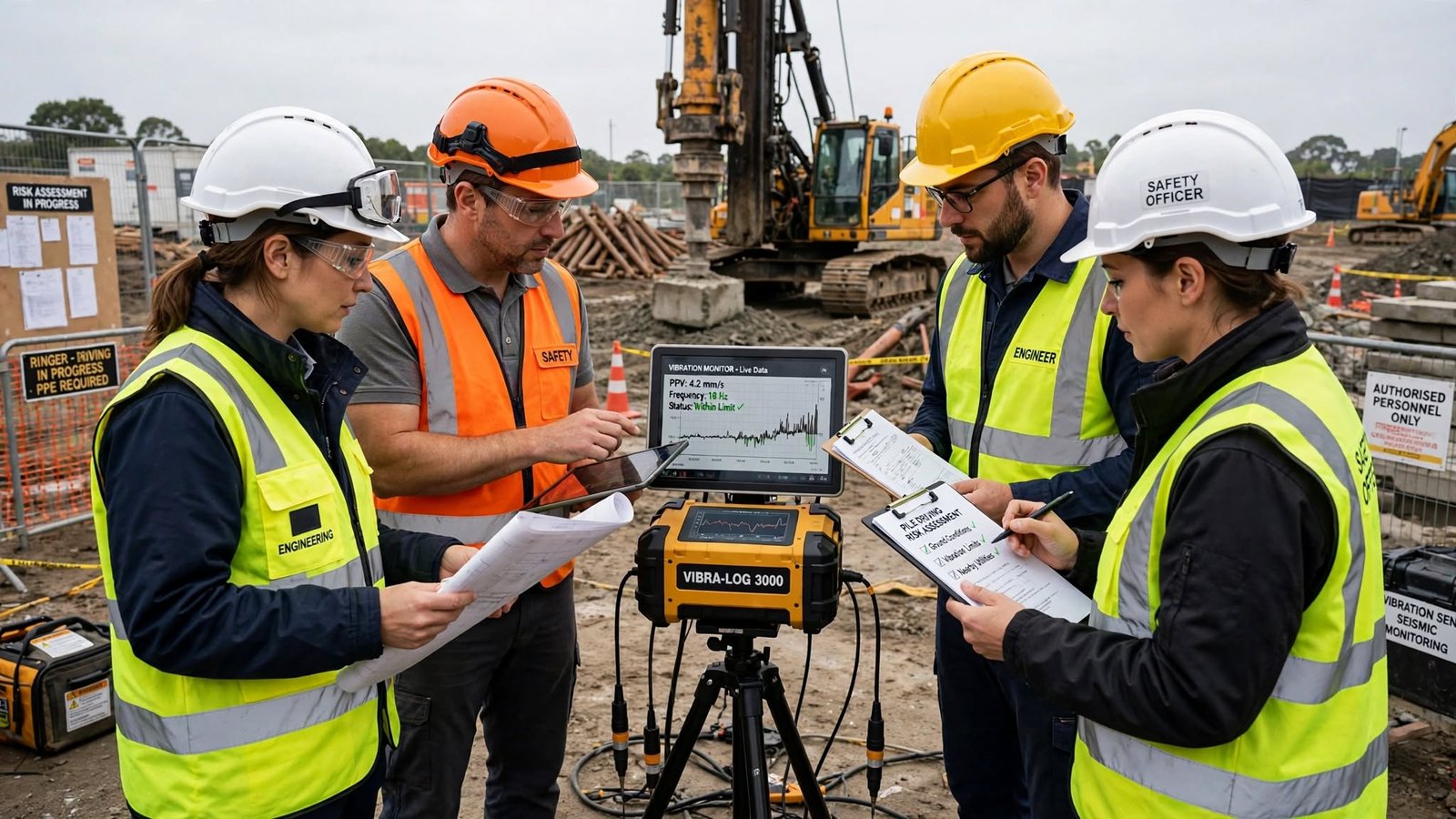
Records save arguments. Dated vibration readings settle questions fast. Without them, every crack in the district becomes the job’s fault.
Where ground is sensitive, the method changes to lower Pile Driving Risks. Rotary drilling. Vibratory driving. Slower, maybe. Quieter and gentler, definitely.
Talking to neighbours before the job starts prevents a lot of trouble. A quick conversation explaining what will happen, for how long, and who to call with concerns goes further than any legal notice. Pile Driving Risks involving disputes shrink when communication happens early.
6. Damage That Stays Hidden
Concrete cracks from the inside. Steel bends a little and keeps going. The pile looks fine at the cut-off. It is not fine.
Overdriving does it. Too much energy for the material. The pile absorbs the abuse until something gives. Worn cushions do the same thing. Shock that should have been absorbed goes into the pile instead, compounding Pile Driving Risks.
A crooked helmet pushes force sideways. The pile bends or splits. Looks straight from above. Fails months later under load.
Visual checks catch some of this. Not all. A crack through the core will not show on the surface. Where the stakes are high, testing fills the gap.
Every pile gets looked at before driving. Cushions get swapped on schedule. Hammer energy matches the pile. Driving stops when the set hits target. Small disciplines. Big protection against Pile Driving Risks.
Cushion wear is the most underrated item on this list. The part costs almost nothing. The damage it prevents costs thousands. Yet crews run cushions past their limit all the time because replacing them takes ten minutes. Ten minutes versus a cracked pile. The math is not close.
7. People Get Tired
Every risk above gets sharper when people are worn down. Human fatigue is the multiplier for all Pile Driving Risks.
A tired operator misses the change in hammer sound. A rushed crew skips the cushion check. An untrained worker stands where nobody should stand.
Training is not a certificate on a wall. It is understanding why the rule exists. A crew that knows the reason respects the boundary. A crew that was simply told to stay clear tests it the moment nobody is watching.
Rest matters too. Twelve-hour shifts produce errors. Errors near heavy equipment put people in hospital.
Culture decides the rest. When the schedule tightens, corners get cut. The crews that hold the line are the ones where someone senior backs the operator who stops the job.
Pile Driving Risks are people risks at the end of the day. Equipment does what it is told. Soil does what it does. People make choices. Every choice either reduces the risk or adds to it.
8. Wrapping It Up
Pile Driving Risks do not vanish with checklists. They get managed, day by day, by people paying attention.
Expect the ground to surprise. Fix equipment before it fails. Guard the fall zone without apology. Watch vibration and noise. Protect pile integrity. Look after the crew. For equipment choices to match your site needs, see typhon skid steer models 7 best sellers that rule the market.
None of it is dramatic. It is quiet work. The kind nobody notices when it is done right to mitigate Pile Driving Risks.
That is the point.
Looking to round out your jobsite fleet? Beyond deep foundation work, many crews also need lifting and access equipment on the same site.
Explore the powerful TYPHON Terror XI 1.1 Ton Mini Excavator Briggs & Stratton USA Engine with Hydraulic Oil Cooler for safe, efficient operations alongside your foundation crew.
9. Our Business Partners
For more details on heavy machinery and to see our business partners at work, check out the video below: