
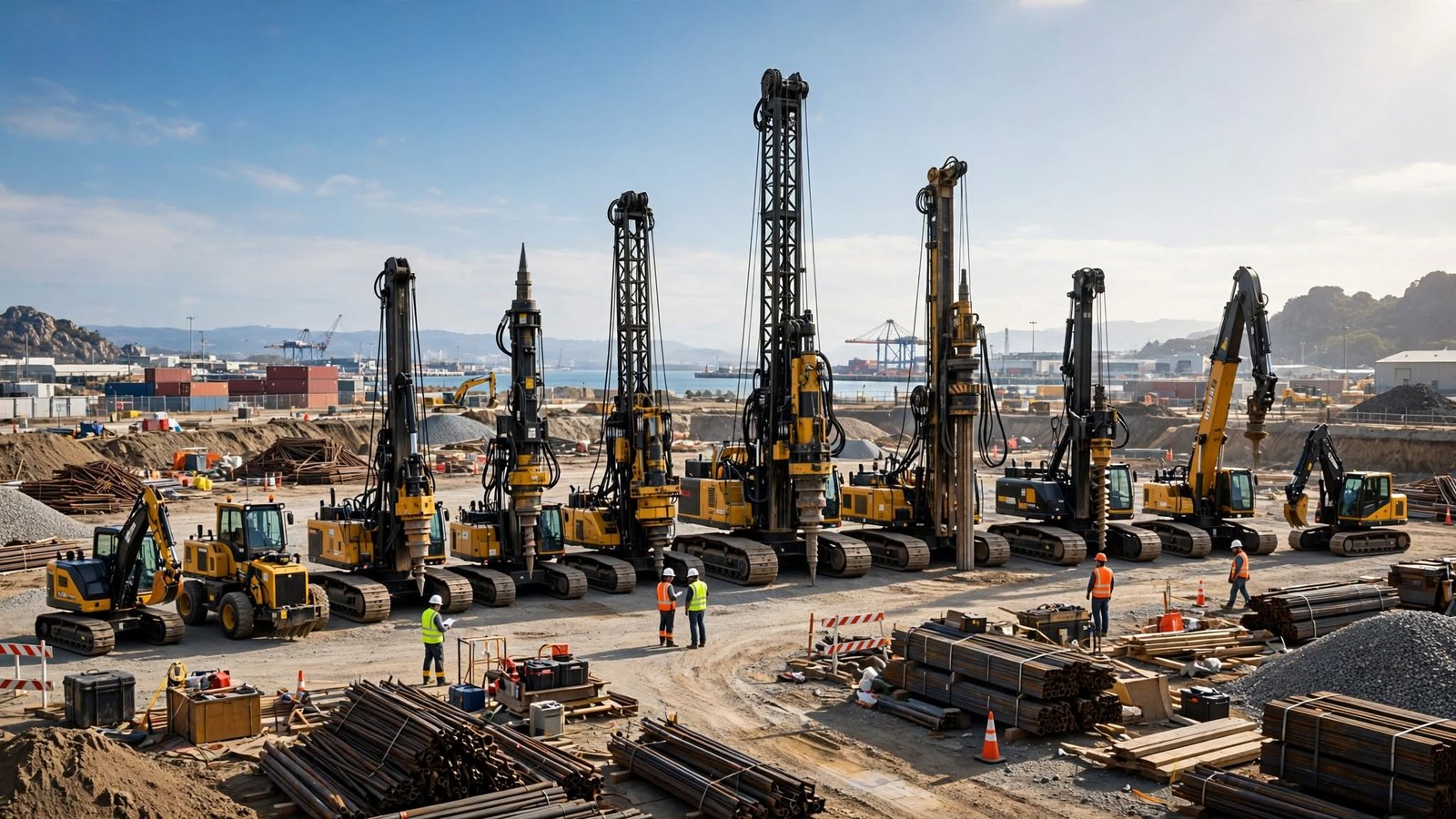
Piledriver Machines: 10 Best Heavy-Duty Models Reviewed 2026

Table of Contents
- 1. Introduction
- 2. Hydraulic Vibrating Pile Driver
- 3. Diesel Pile Driver
- 4. Self Propelled Hydraulic Pile Driver
- 5. Hydraulic Impact Pile Driver
- 6. Vibrating Sheet Pile Driver
- 7. Pneumatic Pile Drivers
- 8. Excavator Mounted Pile Driver
- 9. Diesel Pile Driver with Leads
- 10. Variable Frequency Hydraulic Vibrating Pile Driver
- 11. Compact Tracked Pile Driver
- 12. Conclusion
- 13. Our Business Partners
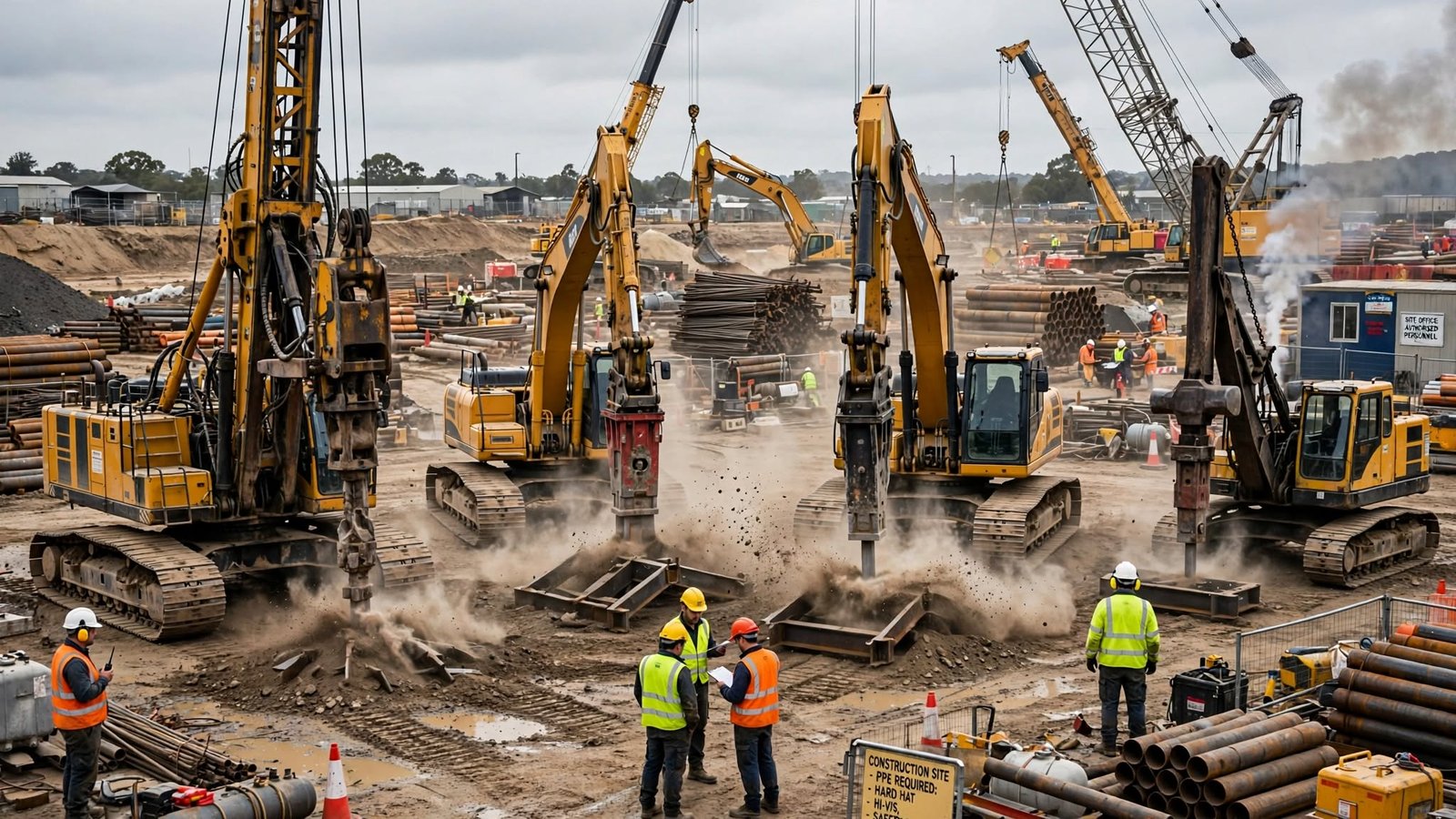
Piledriver Machines are used to drive piles (steel, concrete or timber) into the ground, and provide enough holding force to support structures. Without proper installation, structures will suffer issues like cracks to the walls and subsidence in the floor, years after installation. There are many different Piledriver Machines available. Below is a list of 10 types of Piledriver Machines. A short explanation, and comments on what situations they work best in and what situations they struggle in have also been included.
Hydraulic Vibrating Pile Driver
Vibrating pile drivers vibrate the pile into place. As the weights rotate in opposite directions, the pile receives quick vibrations. This reduces friction in the ground, allowing the pile to be driven with less resistance. Vibration Piledriver Machines work well in sandy and gravelled soils. However, dense clay soils do not work well. In these conditions, it will cause the pile driver to overwork. These specialized Piledriver Machines can be very quiet compared to impact pile drivers. This makes vibrating Piledriver Machines ideal to install piles near residential areas, schools and hospitals. Jobs can also be completed quicker; often in half the time using modern Piledriver Machines.
Diesel Pile Driver
Diesel pile drivers have been in use for many years. The design has not changed drastically from when it was first used. The driver contains one cylinder. As the piston falls, the diesel causes combustion within the cylinder which forces the pile downwards. These Piledriver Machines only require diesel and a crane to operate, making them ideal in remote locations. However, due to loud noise and bad emissions from the machine, diesel Piledriver Machines will not be used in urban areas. If you are in a remote area, and the nearest spare parts shop is an hour away, these Piledriver Machines will continue to work, unlike more advanced units. People either love or loathe diesel Piledriver Machines, and often there is no in-between opinion.
Self Propelled Hydraulic Pile Driver
Not all jobs require large pile drivers. The Turchi 300F model shown below weighs 4500kg, however the rubber track allows it to fit through tight spaces. This makes it ideal for residential installations that may not be accessible by a crane. While the hammer energy (950-1200J) and drop height (approx 4.5m) is not large enough for bridge piers, these Piledriver Machines are suitable for solar farms, barriers, fencing and lighting foundations. For people installing multiple small foundations per week, these versatile Piledriver Machines offer great value. The units can easily transport on a standard trailer between sites.
Hydraulic Impact Pile Driver
If the ground is difficult to penetrate, impact Piledriver Machines can be used. Heavier weight is dropped from a height. The operator can adjust the height and force with which the pile is driven. Softer layers can be gently tapped, and harder layers can be hit with maximum force. These Piledriver Machines have fewer moving parts than vibrating options meaning fewer parts will break down, and if issues occur they can be repaired easily in the yard. In general, heavy-duty Piledriver Machines like this are used first in bridge construction and heavy structural jobs. Concrete piles can also withstand impact better than continuous vibration, so if damage to piles would mean starting again, impact Piledriver Machines may be a better choice.
Vibrating Sheet Pile Driver
Sheet piles can be easily damaged if impacted. To prevent damage to the joint between sheets, the pile can be driven using a vibrating pile driver. As the pile is vibrated, it slides into place without damaging the joints. These robust Piledriver Machines can also be used to extract piles. This can be useful within temporary installations. For example, cofferdams can be extracted when the job has finished, and retaining walls can be extracted once a permanent structure has been put in place. Using Piledriver Machines that can both insert and extract piles can save buying an extra machine. Often, extracting piles can be more profitable than inserting them.
Pneumatic Pile Drivers
Although pneumatic Piledriver Machines are outdated, they are still used on sites. The piston within the pile driver is operated by compressed air. While the initial cost of these drivers is low (cheap pipes and compressors are easy to get hold of), they can be very inefficient. Large amounts of energy are lost as heat and noise. In cold weather, the pipes can freeze and cause delays. Most contractors will use hydraulic Piledriver Machines instead. However, for smaller jobs, or as a secondary machine, pneumatic units can be very useful in the yard. To read about leadership and strategy behind modern equipment development, check out propact series 6 reasons why dennis tan ceo sharing insights.
Excavator Mounted Pile Driver
As most sites have excavators, pile drivers can be mounted to an excavator. The excavator provides the hydraulic pressure to operate the hammer. Fences, signs and lighting can be installed using this configuration. These excavator-mounted Piledriver Machines cannot be used to install foundations for high rises. However, for utilities and landscaping, this is a great option as one machine can do two jobs. When digging starts, the pile driver attachment is removed, and as demand for these excavator attachments never really decreases, they are easy to hire from a rental yard.
Diesel Pile Driver with Leads
Without leads in place, the piles can be out of alignment. This can cause issues with the foundations conforming to the plans. Using leads during installation ensures that the piles are straight. Due to this benefit, bridge and marine workers often use specialized Piledriver Machines equipped with leads. As the leads must be set up, installation can take longer to begin. Once started, all piles will be in the same position. Usually, using Piledriver Machines without leads will result in a higher cost of rectification than the extra set up time.
Variable Frequency Hydraulic Vibrating Pile Driver
Older vibrating pile drivers only had a fixed frequency. With variable frequency Piledriver Machines, the frequency can be adjusted. If the soil is loose, a high frequency is required. However, if the soil is firm (such as dense clay), a low frequency and larger amplitude can be used. This makes the variable frequency Piledriver Machines extremely versatile as they can be used in a variety of ground types. Fewer machines are required, as these advanced Piledriver Machines can adapt to varying soil types.
Compact Tracked Pile Driver
These compact Piledriver Machines can be used in tight spaces. They can be taken through gates and used in backyards where cranes cannot reach. As they have rubber tracks, they will not damage driveways or patios. Small diesel or gas engines allow them to operate. The energy within the hammer is not very high. These mobile Piledriver Machines are ideal for installing foundations in residential properties, supporting decks and small commercial jobs.
Conclusion
The type of pile driver to choose depends on the ground, the pile, and the location. Loose ground types should be driven with vibrating pile drivers. Hard layers should be driven with impact drivers. If the job is in a remote location, diesel drivers may be better. If access is tight, a compact driver may be better. Choosing the correct pile driver for the situation will mean that the rest of the job will generally be easier.
Looking to round out your jobsite fleet? Beyond deep foundation work, many crews also need lifting and access equipment on the same site.
Explore the powerful TYPHON Kuvuo 2.5 KONSTRUCTZ Series 2.5-Ton Open Canopy Mini Excavator with EPA Kubota D1105 Diesel Engine for safe, efficient operations alongside your foundation crew.
Our Business Partners
For more details on heavy machinery and to see our business partners at work, check out the video below: