
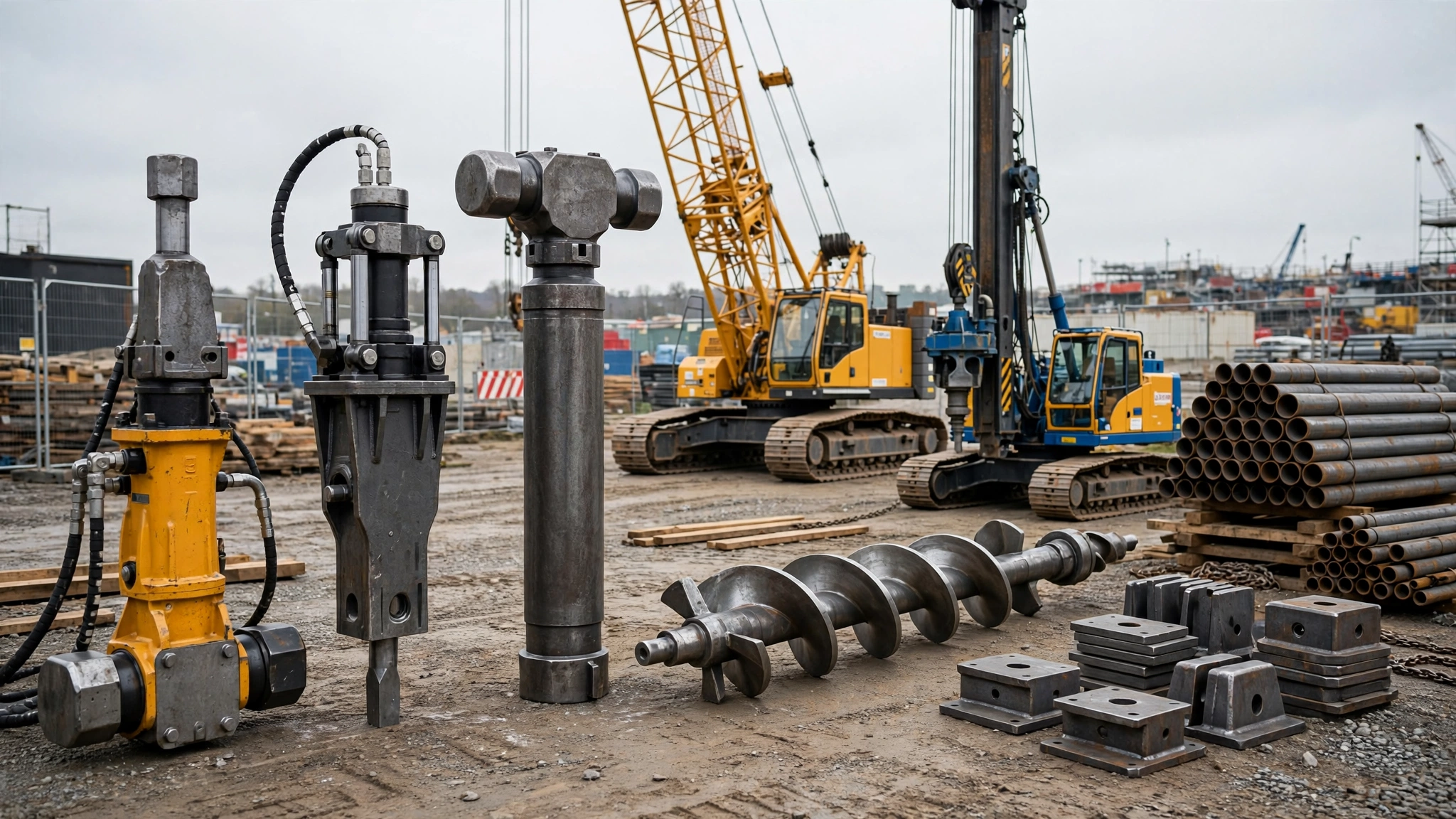
Pile Driving Equipment Guide: 8 Essential Tools Every Contractor Needs

Table of Contents
1. Introduction
Walk onto any pile driving job and the first thing that catches the eye is the hammer. Big machine. Loud noise. Steel pounding into the ground. But the hammer is just one piece of the puzzle. A successful pile job requires a whole lineup of tools, which is why a proper Pile Driving Equipment Guide is essential, each piece playing its part.
Some tools are obvious. Others get overlooked until something goes wrong. That is when the crew starts scrambling. This Pile Driving Equipment Guide covers eight essential tools that every contractor needs on a pile driving job.
Some are big machines. Others are small items that make a huge difference. All of them are necessary for getting the job done right, as outlined in this Pile Driving Equipment Guide. Whether running a small foundation job or a massive bridge project, having the right equipment matters. The wrong tool slows things down. The right tool keeps things moving.
2. The Hammer
The hammer does the actual work. It delivers the force that drives the pile into the ground. Without a hammer, there is no pile driving. Simple as that. The first stop in any Pile Driving Equipment Guide is understanding hammers.
Impact hammers are the classic choice. They use a heavy ram that drops or fires onto the pile head. The repeated blows push the pile deeper with each strike. Diesel hammers run on fuel. The ram compresses fuel and air, and the explosion drives the pile while throwing the ram back up. No external power source needed. Just fuel and the hammer runs. That is why diesel hammers show up on remote sites where electricity is not available.
Hydraulic hammers use fluid power to lift the ram. The ram drops under gravity and hydraulic assist. These hammers deliver consistent energy with every blow. They are quieter than diesel hammers. In 2026, hydraulic hammers dominate urban projects where noise restrictions apply. This is a key insight of the modern Pile Driving Equipment Guide.
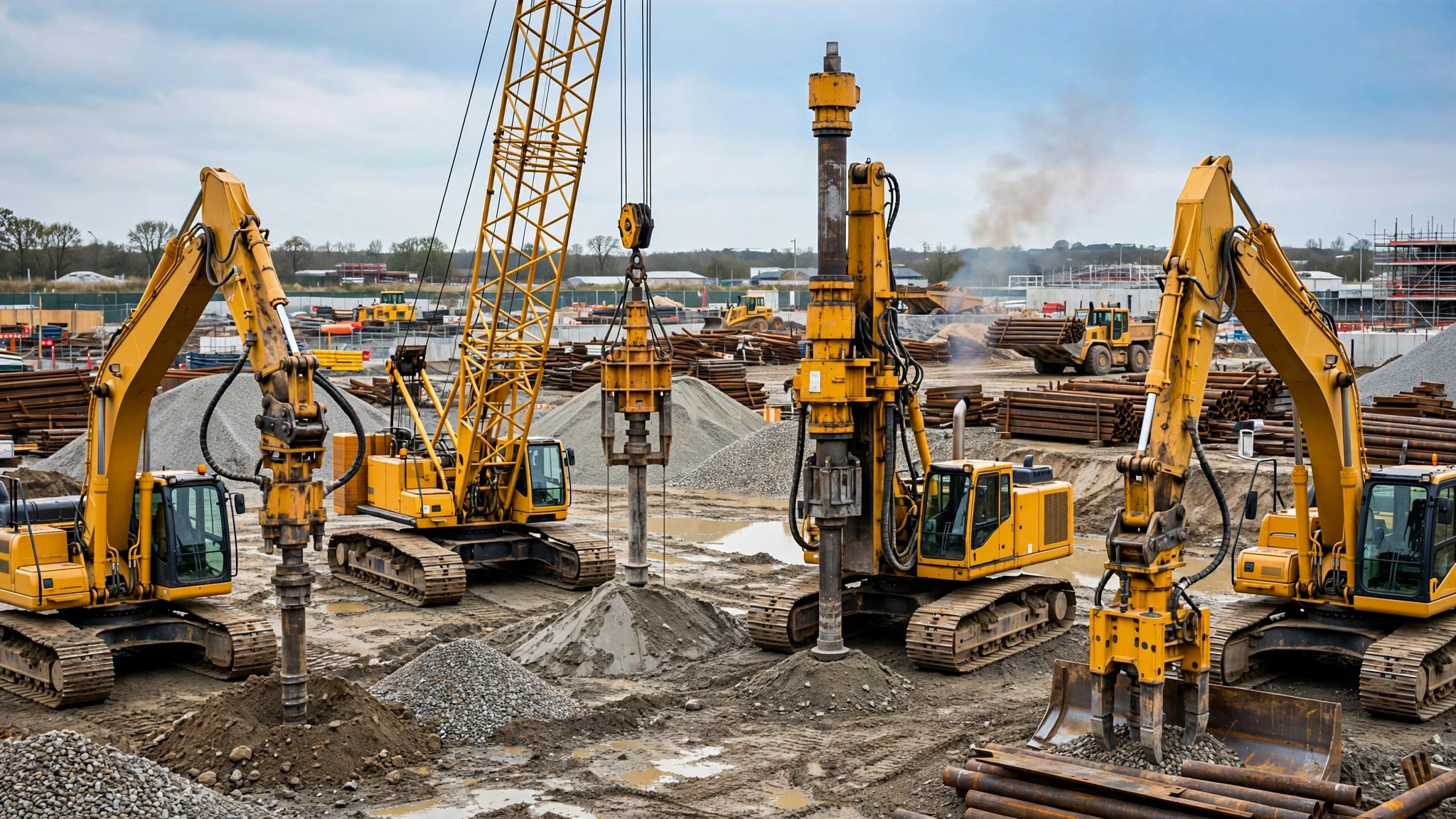
Drop hammers are the oldest type. A weight gets winched up and dropped. No power source except the winch. Slow and old-school, but still useful on small jobs.
Vibratory hammers shake the pile into the ground. Counter-rotating weights create high-frequency vibration. The vibration turns the soil around the pile to liquid for a moment. The pile slides down with little resistance. These hammers work great in sand and gravel. They are faster than impact hammers in those conditions. They are also quieter, which helps in residential areas. But vibratory hammers struggle in clay and hard soil. The shaking does nothing in those conditions. They also cannot prove bearing capacity by blow count.
The hammer choice depends on the soil. Sand and gravel call for vibratory hammers. Clay and silt require impact hammers. Rock needs heavy impact or rotary. Hammer size matters too in the Pile Driving Equipment Guide. A hammer that is too small will not reach bearing. A hammer that is too large will crack the pile. Getting the sizing right is essential.
3. The Power Unit
The hammer needs power to operate. That power comes from a power unit. Without a power unit, the hammer is just a big piece of metal, as taught in the Pile Driving Equipment Guide.
Hydraulic hammers require hydraulic power units. These units pump fluid to the hammer at high pressure. The fluid pressure lifts the ram and controls the stroke. Power units come in various sizes. Larger units deliver more flow and pressure. That translates to more hammer energy. Smaller units work for lighter jobs.
The power unit must match the hammer. Undersized units starve the hammer of power. Oversized units waste fuel and money. This is a fundamental rule in the Pile Driving Equipment Guide.
Diesel hammers do not need external power units. They generate their own power through combustion. The explosion that drives the pile also resets the ram. This self-contained design makes diesel hammers portable. They show up on remote sites where power units are impractical. Some jobs require generator sets. These provide electricity for lights, tools, and other equipment. A reliable generator keeps the job running when utility power is not available.
4. The Crane or Rig
The hammer needs something to hold it up. Something to position it over each pile. That is where the crane or rig comes in, an indispensable part of the Pile Driving Equipment Guide.
Crawler cranes are common on pile driving jobs. The tracks provide stability on soft ground. The boom reaches out to position the hammer. These cranes move around the site easily. But they are heavy. Soft ground can cause them to sink. Timber mats or steel plates help distribute the weight.
Some pile driving rigs mount on excavator bases. The excavator provides the mobility. The boom holds the leads and hammer. Excavator-mounted rigs work well in tight spaces. They maneuver easily around obstacles. They are also cheaper than dedicated pile driving rigs.
Dedicated rigs are purpose-built for pile driving. They have longer leads and more powerful winches. They handle larger piles and deeper driving. These rigs cost more than excavator-mounted options. But they deliver better performance on large jobs, making them a premium choice in the Pile Driving Equipment Guide.
5. The Leads
The leads guide the hammer and keep the pile straight. Without leads, the pile would go in crooked. Simple as that. The Pile Driving Equipment Guide always stresses alignment.
Fixed leads attach directly to the crane or rig. They stay in one position. The rig moves to reposition them. Fixed leads are simple and reliable. They work well for straight piles in open areas.
Swinging leads pivot at the base. The operator can angle them without moving the rig. This allows driving piles at different angles. Swinging leads are useful for batter piles. Batter piles go in at an angle. They provide lateral support to the structure.
Lead alignment matters. A small angle at the top becomes a big shift at the bottom. Misaligned leads cause crooked piles. Modern leads include alignment tools. Laser levels and digital inclinometers help keep things straight. Checking alignment before every pile prevents problems, an essential tip from the Pile Driving Equipment Guide.
6. The Pile Cap and Cushion
The pile cap sits on top of the pile. It spreads the hammer blow evenly across the pile head. Without a pile cap, the pile would crack, which is a major failure in any Pile Driving Equipment Guide.
Pile caps are made of steel. They fit over the pile head like a helmet. The hammer strikes the cap, not the pile directly. Caps come in different sizes. The cap must match the pile. A loose cap shifts on impact. A tight cap distributes the blow properly.
Cushions go between the hammer ram and the pile cap. They absorb shock and protect both the hammer and the pile. Cushions wear out over time. The pounding compresses them. Worn cushions waste energy and crack piles. Replacing cushions regularly prevents problems.
Cushion material matters according to the Pile Driving Equipment Guide. Some piles need soft cushions. Others need hard ones. Using the wrong material chews through cushions fast. Plywood is common for concrete piles. It provides enough give to protect the concrete. Steel piles can handle harder cushions.
7. The Winch
The winch raises and lowers the hammer. It also lifts piles into position. Without a winch, nothing moves on site. The Pile Driving Equipment Guide highlights its importance.
The main winch handles the hammer. It lifts the ram for each blow. It also lowers the hammer onto the pile. Main winches need to be powerful. The ram is heavy. Lifting it takes torque. Underpowered winches slow down the job.
Auxiliary winches handle other tasks. They lift piles into position. They move equipment around the site. Having two winches speeds things up. The main winch handles the hammer. The auxiliary winch handles the piles.
Winches need regular maintenance. Cables wear out. Brakes need adjustment. A broken winch stops the entire job. Inspecting cables daily prevents accidents. Replacing worn cables before they break saves time and money, a golden rule in the Pile Driving Equipment Guide.
8. The Pile Handler
The pile handler grabs and positions each pile. It lifts the pile from the ground and swings it into place, a necessary component of the Pile Driving Equipment Guide.
Hydraulic grabbers clamp onto the pile. The operator controls the clamp from the cab. The grabber holds the pile securely during positioning. Grabbers work with various pile sizes. Adjustable jaws accommodate different diameters. Some grabbers handle both steel and concrete piles.
Cable slings wrap around the pile. The crane lifts the pile using the sling. This method works well for smaller piles. Slings require careful rigging. The pile can slip if rigged improperly. Proper training prevents accidents.
Magnet lifters attach to steel piles. The electromagnet holds the pile securely. The operator releases the pile with a switch. Magnets speed up handling. They do not require rigging or slings. But they only work on steel piles as taught by the Pile Driving Equipment Guide.
9. The Compressor
Compressed air powers many tools on a pile driving job. A reliable compressor keeps those tools running efficiently, an overlooked part of the Pile Driving Equipment Guide.
Some tools run on compressed air. The compressor provides the air pressure. The tools use that pressure to operate. Air-powered tools include drills, hammers, and cleaning equipment. They are simple and reliable. They also run safely in wet conditions.
Jetting uses compressed air or water to loosen soil. High-pressure jets spray ahead of the pile. The loosened soil allows easier driving. Jetting helps in dense soil. It reduces driving resistance. It also helps in sandy soil where the pile needs to go deeper.
Compressed air cleans equipment. It blows dust and debris off critical parts. Keeping equipment clean extends its life, extending the value of your Pile Driving Equipment Guide inventory.
10. Wrapping It Up
A successful pile job requires more than just a hammer. It takes a full lineup of equipment working together. This Pile Driving Equipment Guide has covered the essentials.
The hammer delivers the force. The power unit supplies the energy. The crane holds everything up. The leads keep things straight. The pile cap protects the pile. The winch raises and lowers. The handler positions each pile. The compressor runs the tools. Each piece plays its part.
Missing any piece slows down the job. Having the right equipment makes the difference between smooth progress and constant struggles. It is also important to learn from the 10 critical mistakes that ruin your pile project to avoid disaster.
Invest in quality equipment. Maintain it properly based on your Pile Driving Equipment Guide. Train the crew to use it correctly. That is how pile jobs get done right.
Looking to round out your jobsite fleet? Beyond deep foundation work, many crews also need lifting and access equipment on the same site.
Explore the powerful TYPHON STOMP V1000 24HP Kubota D1105 Water-Cooled Diesel Skid Steer Pilot Control for safe, efficient operations alongside your foundation crew.
11. Our Business Partners
For more details on heavy machinery and to see our business partners at work, check out the video below: