
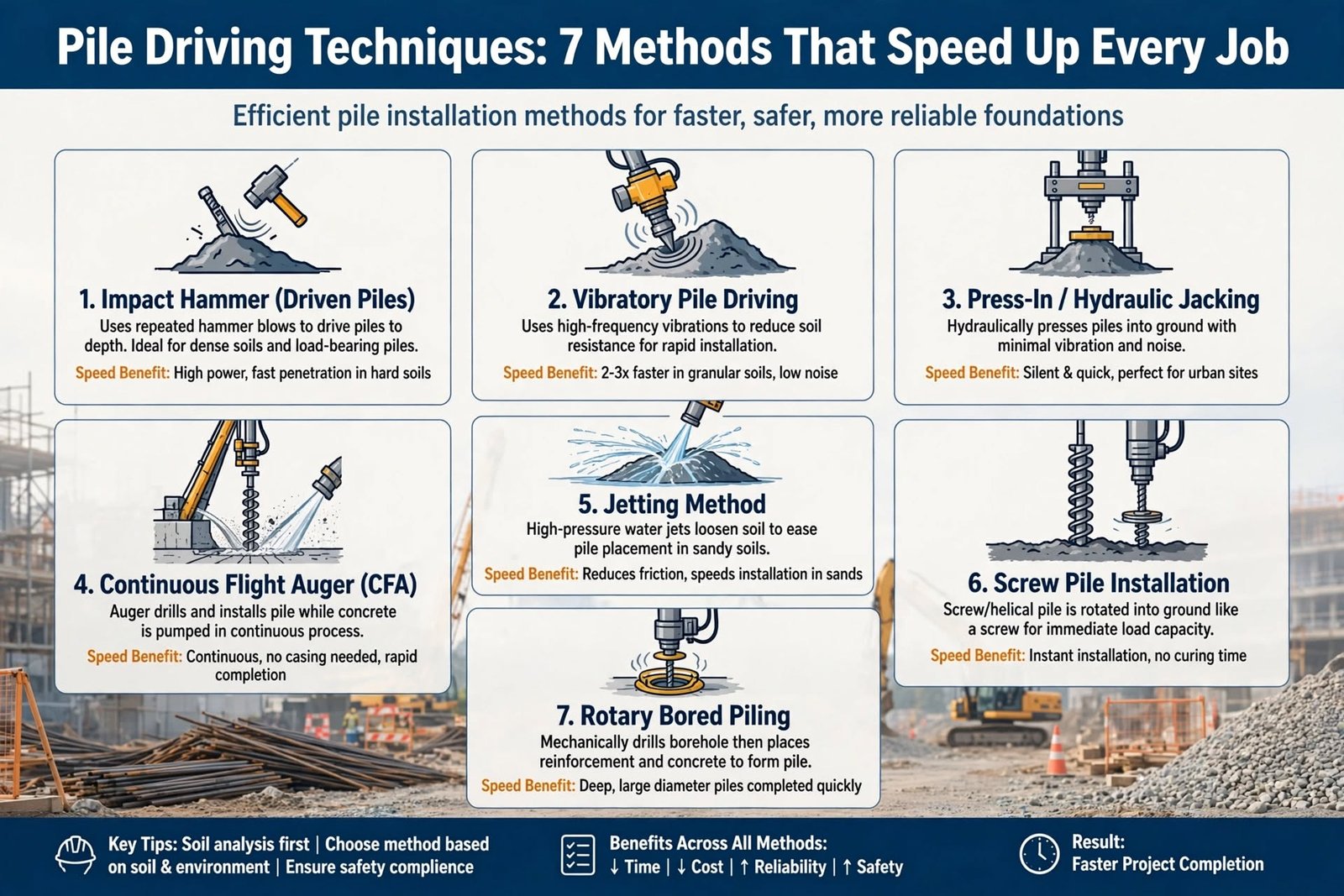
Pile Driving Techniques: 7 Methods That Speed Up Every Job

Table of Contents
- 1. Introduction
- 2. Adjust Hammer Energy to Match the Soil
- 3. Pre-Drill Through Hard Layers
- 4. Use Vibratory Hammers in the Right Soil
- 5. Stage Piles Near the Point of Use
- 6. Maintain Alignment Without Constant Adjustment
- 7. Reduce Transition Time Between Piles
- 8. Track Output and Fix Bottlenecks
- 9. Wrapping It Up
- 10. Our Business Partners
1. Introduction
Every discussion on Pile Driving Techniques should start with a simple fact. Two crews can work the same site with the same equipment and get completely different results. One crew drives thirty piles in a day. The other drives fifteen. Same hammer. Same soil. Same weather. Different outcome.
The difference comes down to technique. How the hammer is operated. How the piles are prepared. How the crew works together. Small adjustments in method create big gains in output.
This guide to Pile Driving Techniques covers seven methods that speed up every job. Some are well known. Others get overlooked. All of them work. Apply them and the daily count climbs. Ignore them and the schedule slips.
2. Adjust Hammer Energy to Match the Soil
Every hammer has settings. Stroke length. Energy output. Blow rate. Most operators pick a setting and leave it there. That is a mistake. The right setting for one soil is wrong for another.
Soft soil needs less energy. The pile moves easily. High energy wastes fuel and stresses the equipment. It can also damage the pile if the resistance is low.
Hard soil needs more energy. The pile resists. Low energy means more blows to reach depth. More blows mean more time. More time means lower output.
Check the soil at each pile location. Not every pile sits in the same ground. Conditions change across a site. A pile in sand drives differently than a pile in clay.
Start with moderate energy. Watch the blow count. If the pile moves easily, reduce energy. If progress is slow, increase energy. Make adjustments as conditions change, utilizing proper Pile Driving Techniques.
Train operators to read the signs. The sound of the hammer. The feel of the rig. The movement of the pile. These signals tell the operator what to do.
The best operators develop a feel for the hammer as part of their Pile Driving Techniques. They know when it is working too hard. They know when it is loafing. They adjust without being told. That skill comes from experience and attention.
3. Pre-Drill Through Hard Layers
Hard layers stop piles cold. The hammer pounds and the pile refuses to move. The operator keeps hitting. The pile cracks. The job stops.
Pre-drilling solves this problem and is one of the most effective Pile Driving Techniques. A pilot hole gets drilled through the hard layer before the pile is driven. The pile then follows the hole through the obstruction.
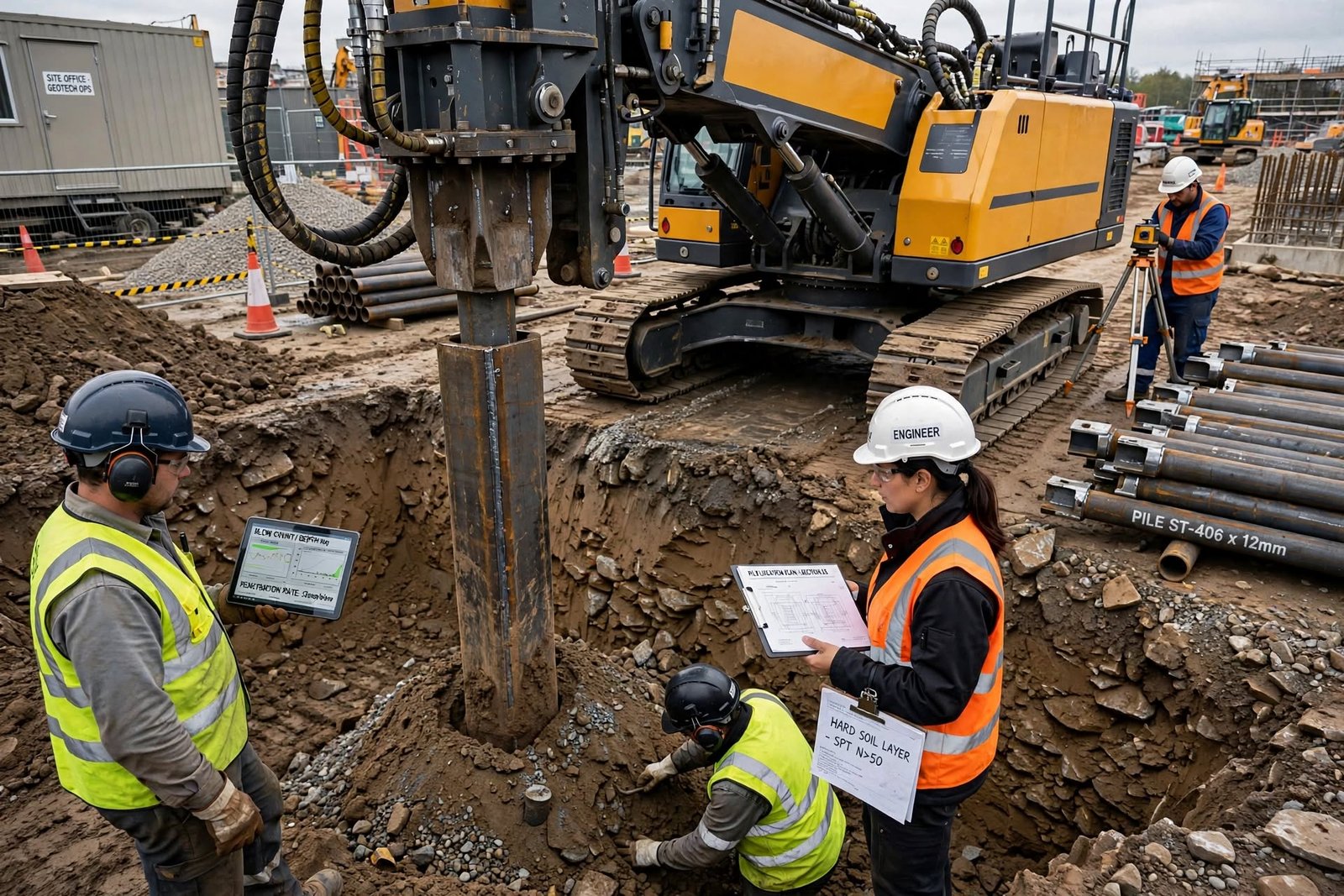
Identify hard layers during site investigation. Test holes reveal where the problems are. Plan pre-drilling for those areas before the job starts.
Use the right size auger. Too small and the pile still hits resistance. Too large and the pile loses friction. Match the pilot hole to the pile.
Pre-drill just ahead of driving. Do not pre-drill the entire site at once. Soil can collapse into the holes. Pre-drill each pile just before it gets driven.
This technique adds a step. But mastering such Pile Driving Techniques saves time overall. A pile that refuses without pre-drilling takes hours to fix. A pile that follows a pilot hole goes in minutes.
Pre-drilling also reduces vibration. The pilot hole removes some of the resistance. The hammer does not need to work as hard. Less vibration means less risk to nearby structures.
The cost of pre-drilling is offset by the time saved. One extra machine and operator. But the driving goes faster. The job finishes sooner. The math works out.
4. Use Vibratory Hammers in the Right Soil
Vibratory hammers are fast. In sand and gravel, they drive piles in a fraction of the time impact hammers need. The vibration liquefies the soil and the pile slides down.
But vibratory hammers do not work everywhere. In clay, they do nothing. The cohesive soil does not liquefy. The pile sits there shaking while the crew waits.
Match the hammer to the soil, a fundamental rule in advanced Pile Driving Techniques. Sand and gravel call for vibratory. Clay and silt call for impact. Rock calls for impact or rotary.
Use vibratory hammers for sheet piles. The interlocking sections drive quickly in granular soil. The whole wall goes in fast.
Combine methods when needed, applying multiple Pile Driving Techniques for different conditions. Pre-drill through hard layers. Then switch to vibratory for the granular layers. Different tools for different conditions.
Vibratory hammers also extract piles. If a pile needs to come out, the vibratory hammer pulls it quickly. That saves time on change orders.
The key is knowing when to use vibratory and when to switch between various Pile Driving Techniques. A crew that forces a vibratory hammer into clay wastes the whole day. A crew that switches methods when conditions change keeps the job moving.
5. Stage Piles Near the Point of Use
The pile handler moves piles from storage to the rig. If the storage area is far away, that movement takes time. Every trip costs minutes. Those minutes add up.
High-output crews stage piles close to where they get driven, a logistical step in modern Pile Driving Techniques. The handler grabs a pile and moves it a short distance. The cycle time drops.
Plan the storage layout before the job starts. Put piles where they will be needed. Not all in one corner of the site.
Use multiple staging areas. As the work moves across the site, move the piles with it. Keep the distance short.
Stage the next pile while the current one is being driven. The handler positions the pile before the hammer finishes. When the hammer stops, the next pile is ready.
This technique requires coordination. Proper Pile Driving Techniques dictate that the handler needs to know which pile comes next. The ground crew needs to know where it goes. Communication makes it work.
The time savings are significant. Cutting the travel distance in half cuts the cycle time. More piles get driven per shift. The schedule stays on track.
Staging also improves safety. Shorter moves mean less exposure to hazards. The handler spends less time in the danger zone. The whole operation runs smoother.
6. Maintain Alignment Without Constant Adjustment
Alignment problems slow everything down. The pile drifts. The operator stops. The crew adjusts. Driving resumes. Then it drifts again. The cycle repeats.
Good alignment starts with good setup, which is heavily emphasized in expert Pile Driving Techniques. The leads need to be plumb. The helmet needs to be centered. The rig needs to be stable. Get these right and the pile goes in straight.
Check alignment before every pile. Use laser levels or digital inclinometers. Do not guess. Measure.
Fix alignment problems immediately. Small drift becomes big drift. Catching it early saves time.
Use quality helmets and cushions. Worn or off-center helmets cause drift. Replace them before they cause problems.
Monitor alignment during driving. If the pile starts to wander, stop and correct. Do not keep driving and hope it straightens out. It will not.
A pile that goes in straight the first time saves the crew from pulling it out and starting over. That saves hours. Pulling a pile is slow and expensive. Driving it right the first time is always faster.
The best crews check alignment constantly using proven Pile Driving Techniques. They do not wait for a problem to appear. They catch it before it starts. That habit keeps the job moving.
7. Reduce Transition Time Between Piles
The time between piles is where productivity dies. The hammer stops. The pile gets moved. The rig repositions. The next pile gets aligned. By the time driving starts again, ten minutes have passed.
Ten minutes times thirty piles is five hours. A whole shift lost to transition time.
Plan the transition. Refining this is a major part of efficient Pile Driving Techniques. Every task gets assigned. The handler knows where to place the next pile. The ground crew knows what to check. The operator knows where to position the leads.
Prepare the next pile during driving. The hammer drives the current pile while the crew readies the next one. When the hammer stops, the next pile is in position.
Streamline the process by utilizing lean Pile Driving Techniques. Remove unnecessary steps. Combine tasks where possible. Save two minutes per pile and gain an hour per day.
Practice makes perfect. The first few transitions are slow. The crew learns the routine. The transitions get faster. Eventually they become automatic.
The crew that masters transitions can double output. Not by working faster. By eliminating waste. The driving itself takes the same time. The time between piles drops. More piles get driven with the same effort.
Transition time is invisible waste. It does not show up in the estimate. It does not show up in the schedule. But it shows up in the daily count. Eliminate it and the count climbs.
8. Track Output and Fix Bottlenecks
You cannot improve what you do not measure. Crews that track output see where time gets lost. Crews that do not track output never improve.
Tracking reveals bottlenecks that can be fixed with better Pile Driving Techniques. Maybe alignment takes too long. Maybe the hammer needs adjustment. Maybe the pile staging is inefficient. The numbers show the problem.
Record everything. Time per pile. Delays and causes. Blow counts. Set measurements. All of it goes into a log.
Review the log daily. Look for patterns. Where does time get lost? What causes the delays?
Fix the biggest bottleneck first. If alignment takes too long, focus on alignment. If staging is slow, move the piles closer. Address one problem at a time.
Share the numbers with the crew. Everyone should know the target. Everyone should know the actual. When the numbers improve, celebrate. When they slip, investigate.
Tracking creates accountability. The crew knows the numbers matter. They work to improve them. The habit becomes part of the culture.
The best crews track everything to improve their Pile Driving Techniques. They know their production rate. They know their delays. They know their costs. That knowledge drives improvement. Without it, the crew is guessing.
Tracking also helps with bidding. A crew that knows its numbers bids more accurately. They know how long a job will take. They know what it will cost. That knowledge wins jobs and protects margins. For more on this, explore how pile driving productivity 6 habits that double your output.
9. Wrapping It Up
Speed on a pile driving job comes from technique. Mastering Pile Driving Techniques means the right hammer settings. Pre-drilling through hard layers. Matching the hammer to the soil. Staging piles efficiently. Maintaining alignment. Reducing transition time. Tracking output.
None of these Pile Driving Techniques are complicated. But they require discipline. Crews that apply them drive more piles with less effort. Crews that ignore them struggle to meet the schedule.
Start with one technique. Get it right. Add another. Over time, the gains compound. Mastering these Pile Driving Techniques ensures the job gets done right. A crew that drives fifteen piles a day starts driving thirty. The schedule gets easier. The budget looks better.
Looking to round out your jobsite fleet? Beyond deep foundation work, many crews also need lifting and access equipment on the same site.
Explore the powerful TYPHON Thunderdump Lift Konstructz Series Tracked Dumper 2205 lb Load Capacity Honda GX390 11HP Gas Engine for safe, efficient operations alongside your foundation crew.
10. Our Business Partners
For more details on heavy machinery and to see our business partners at work, check out the video below: