
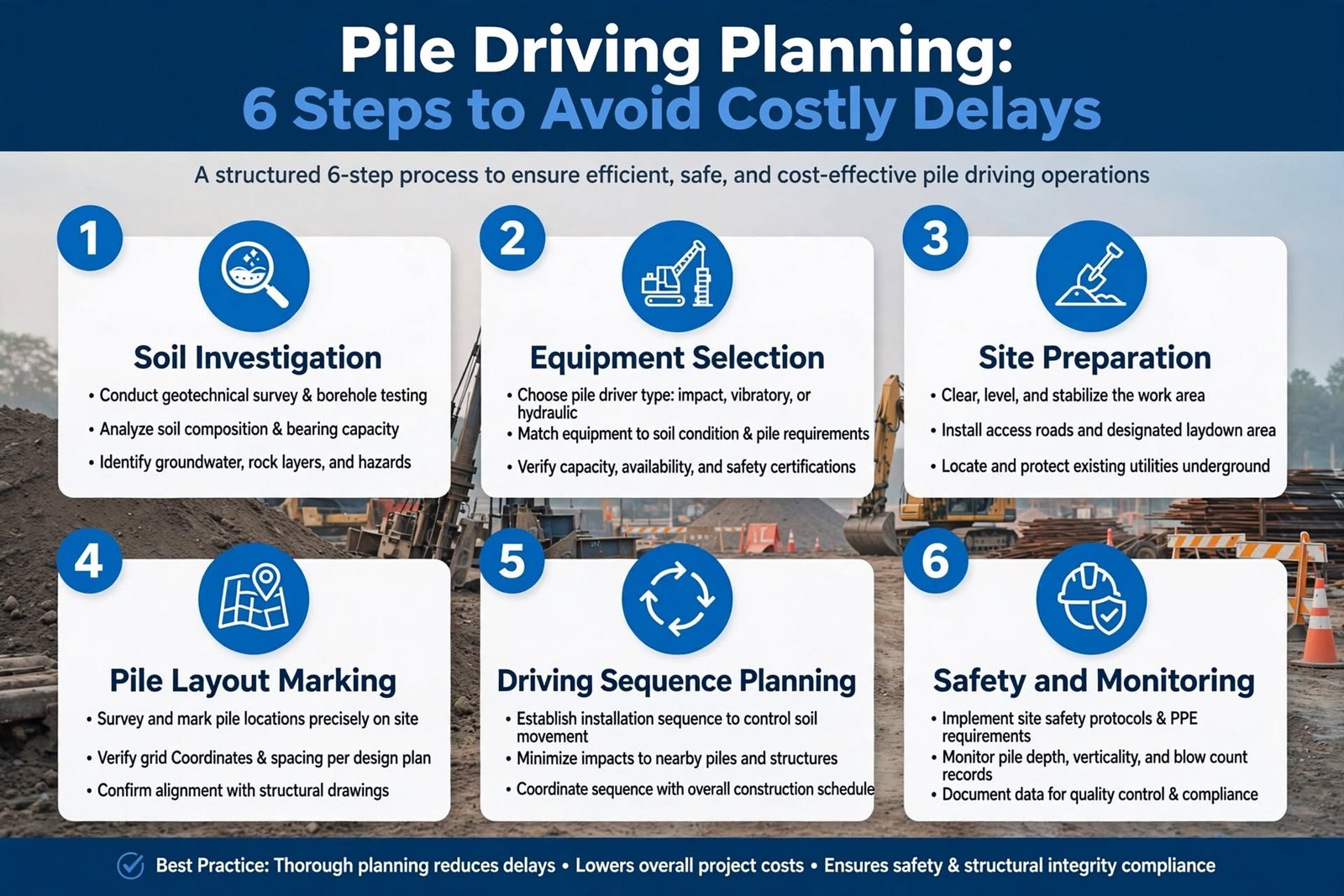
Pile Driving Planning: 6 Steps to Avoid Costly Delays

Table of Contents
- 1. Introduction
- 2. Complete the Site Investigation Before Anything Else
- 3. Secure Permits and Approvals Early
- 4. Match Equipment to the Actual Conditions
- 5. Build Realistic Schedules with Buffer Time
- 6. Coordinate with Other Trades and the Client
- 7. Plan for the Unexpected
- 8. Wrapping It Up
- 9. Our Business Partners
1. Introduction
Every Pile Driving Planning conversation should start with a hard truth. Most delays are not accidents. They are the result of poor preparation. Someone skipped a step. Someone assumed something. Someone decided to save a few dollars now and paid for it later.
A delayed pile driving job bleeds money. Equipment keeps costing. Labor keeps costing. Other trades wait. The client gets angry. The schedule falls apart. And once a job falls behind, it rarely catches up without proper Pile Driving Planning.
This Pile Driving Planning piece covers six steps that keep jobs on schedule. None of them are complicated. All of them work. Skip them and the delays come. Follow them and the schedule holds.
2. Complete the Site Investigation Before Anything Else
The site investigation is the foundation of every Pile Driving Planning decision. Skip it and everything that follows is a guess.
Soil conditions decide the equipment. They decide the pile type. They decide the depth. Without knowing what is underground, no plan can be accurate.
Most delays trace back to a surprise underground. A boulder that was not on the drawings. A soft layer where hard soil was expected. A water table higher than anticipated. Every surprise costs time. Pile Driving Planning anticipates this.
How to Complete This Step
Hire a geotechnical engineer before the job starts. Drill test holes at regular intervals across the site. Send samples to a lab for analysis.
Get a full report. Soil composition. Bearing capacity. Water table depth. Problem layers. Everything that matters for the job should be documented in your Pile Driving Planning file.
Test multiple locations. Conditions change across a site. One test hole is not enough. A grid of test holes provides a complete picture.
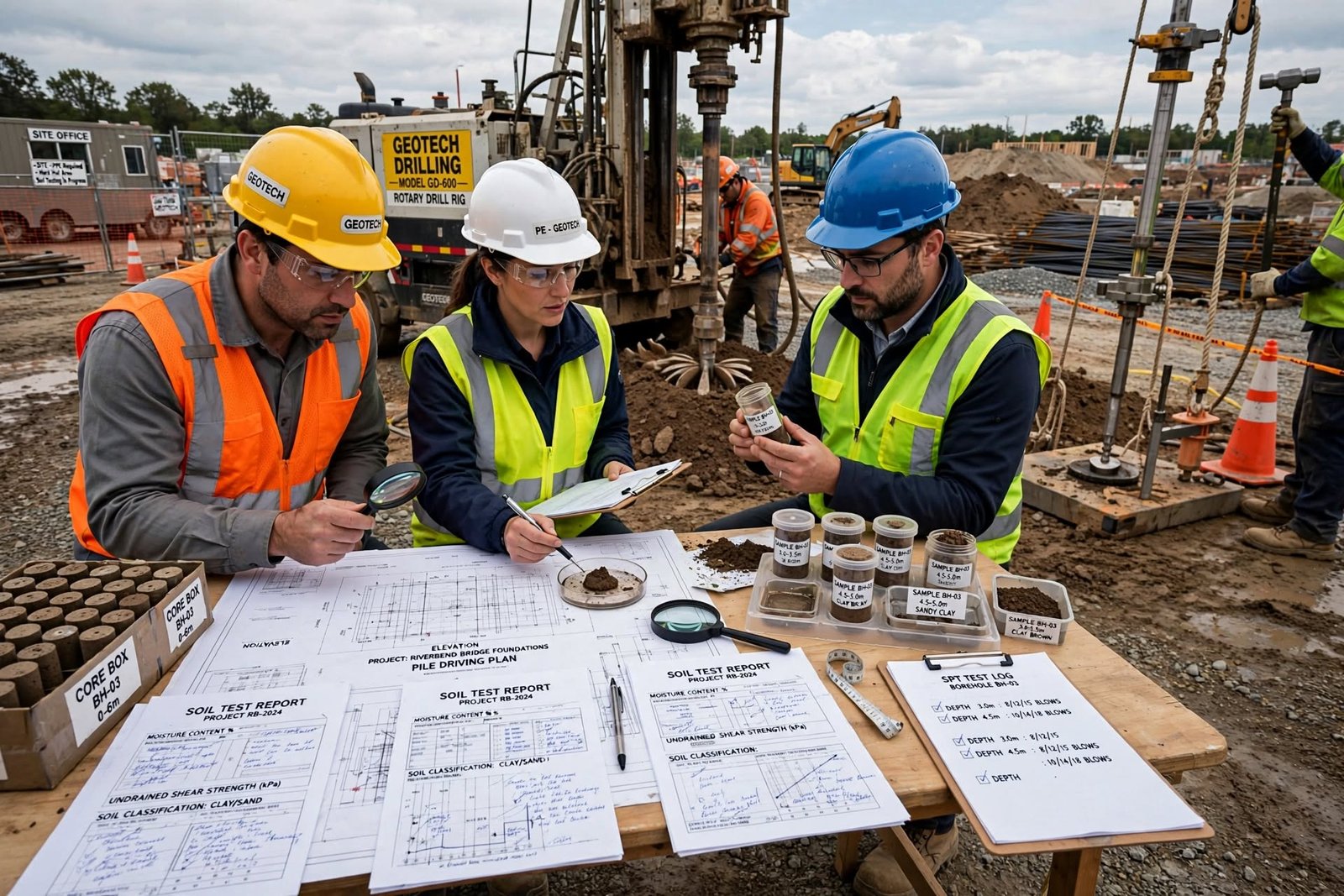
Review the report with the crew before mobilizing. Everyone should know what to expect. The operator should know where the hard layers are. The foreman should know where the water table sits.
The investigation costs money. But it is nothing compared to the cost of a delay. A single surprise underground can shut down the job for days. The investigation prevents those surprises, proving the value of Pile Driving Planning.
3. Secure Permits and Approvals Early
Permits take time. Sometimes weeks. Sometimes months. The job cannot start until they are in hand. Starting late means finishing late, a major failure in Pile Driving Planning.
Every city has different requirements. Noise permits. Vibration permits. Right-of-way permits. Building permits. The list goes on.
Apply for every permit as early as possible. Do not wait until the last minute. Do not assume the permit will arrive quickly.
How to Complete This Step
Call the local building department before the job starts. Ask what permits are required. Ask how long each one takes. This is a basic rule of Pile Driving Planning.
Submit applications early. Include everything the department asks for. Missing documents cause delays. Incomplete applications get rejected.
Follow up on every application. Do not wait for the department to call. Call them. Check the status. Keep the process moving.
Coordinate with other trades. If the foundation needs a permit, the trades above need to know the timeline. Everyone should plan around the same schedule. That is efficient Pile Driving Planning.
Permits are paperwork. But paperwork delays kill jobs. Treat permit applications as urgent. The sooner they are approved, the sooner the job starts.
4. Match Equipment to the Actual Conditions
Equipment selection happens during Pile Driving Planning. The wrong choice slows the job down. The right choice keeps it moving.
Impact hammers work in clay and silt. Vibratory hammers work in sand and gravel. Rotary rigs work in rock and mixed soil. Match the equipment to the ground.
Hammer size matters too. Too small and the pile never reaches bearing. Too big and the pile cracks. Getting this wrong costs time and money. Correctly sizing machinery is vital in Pile Driving Planning.
How to Complete This Step
Review the soil report before choosing equipment. Match the hammer to the soil conditions. Do not guess. Use the data.
Consider the pile type. Concrete piles need different hammers than steel piles. The energy must match the material.
Plan for equipment changes. If conditions change mid-job, have a backup plan. Renting a different hammer takes time. Knowing where to get one saves delay, an expert tip in Pile Driving Planning.
Keep spare parts on site. Cushions. Hoses. Cables. Small parts cause big delays when they fail. Having spares means quick repairs.
Train the operator on the equipment. A machine is only as good as the person running it. An experienced operator gets more from the hammer.
Equipment delays are common. A broken hammer. A slow winch. A worn cushion. Prevent them with maintenance. Fix them quickly with spares. Every hour of downtime is an hour of delay.
5. Build Realistic Schedules with Buffer Time
Optimistic schedules fail. Every time. Pile Driving Planning requires realism, not hope.
Weather delays. Equipment breakdowns. Material shortages. Permits. Inspections. All of these take time. A schedule that ignores them is a schedule that breaks.
Build buffer time into the plan. Add days for weather. Add days for equipment issues. Add days for inspections. Buffer is necessary for proper Pile Driving Planning.
How to Complete This Step
Estimate the production rate. How many piles per day can the crew realistically drive? Base the estimate on similar jobs, not on best-case scenarios.
Add buffer for weather. Rain stops work. Extreme heat slows work. Plan for the season.
Add buffer for equipment. Breakdowns happen. Downtime happens. Build slack into the schedule.
Add buffer for inspections. Inspectors are busy. They do not always come when called. Plan for delays. Pile Driving Planning assumes things will go wrong.
Review the schedule with the crew. Get their input. They know the site. They know the conditions. Their feedback makes the schedule more accurate.
Communicate the schedule with the client. Explain the buffer time. Most clients understand. They prefer a realistic schedule over one that breaks.
A realistic schedule prevents panic. When delays happen, the buffer absorbs them. The job stays on track. The client stays calm.
6. Coordinate with Other Trades and the Client
Pile driving does not happen in isolation. Other trades need the foundation. Other trades wait for the piles. Coordination prevents conflicts. It is the social aspect of Pile Driving Planning.
Delays often come from poor communication. The pile crew does not know the concrete crew is waiting. The client does not know the schedule changed. Everyone works at cross purposes.
How to Complete This Step
Meet with the client before the job starts. Explain the plan. Explain the schedule. Explain the risks.
Meet with other trades. Find out when they need the foundation. Plan the pile driving around their needs. Open communication is great Pile Driving Planning.
Set up communication channels. Regular meetings. Shared schedules. Everyone should know what is happening.
Update everyone when things change. Delays happen. Weather happens. Equipment breaks. The client and other trades should know.
Coordinate deliveries. Piles arrive when needed. Equipment arrives when needed. Nothing sits around waiting.
Good coordination prevents surprises. Everyone knows what to expect. The job runs smoothly.
7. Plan for the Unexpected
Every job has surprises. The plan never survives contact with reality. Pile Driving Planning requires flexibility.
What happens if a pile refuses early? What happens if the soil changes? What happens if the hammer breaks? These questions need answers before the job starts.
How to Complete This Step
Create contingency plans. For each major risk, plan the response. If the pile refuses, pre-drill. If the soil changes, switch equipment. If the hammer breaks, use the spare. Solid Pile Driving Planning covers all bases.
Keep backup equipment available. Know where to rent a replacement. Know how long delivery takes.
Budget for contingencies. Add a line item for unexpected costs. Surprises cost money. Having budget prevents panic.
Train the crew on contingency plans. Everyone should know what to do when things go wrong. No one should stand around waiting for instructions. Discover more about managing efficiency by exploring pile driving productivity 6 habits that double performance on site.
Review the plan after every job. What went wrong? What worked? Apply the lessons to the next job. Reviewing past work is a critical step in Pile Driving Planning.
Contingency planning is not pessimism. It is realism. Every job has problems. The crews that plan for them handle them better.
8. Wrapping It Up
Delays are expensive. They cost money. They cost reputation. They cost future work. Avoiding them requires solid Pile Driving Planning.
Complete the site investigation. Secure permits early. Match equipment to conditions. Build realistic schedules. Coordinate with everyone. Plan for the unexpected.
These six steps make up the core of Pile Driving Planning. Follow them and the delays drop. Skip them and the delays multiply.
Every delay is preventable. Not every delay can be avoided. Weather happens. Equipment breaks. But most delays come from poor planning. Fix the planning and most delays disappear.
Start with the investigation. Get the data. Make the decisions. Plan the work. Communicate the plan. Prepare for problems. That is how jobs finish on time.
That is the power of good Pile Driving Planning.
Looking to round out your jobsite fleet? Beyond deep foundation work, many crews also need lifting and access equipment on the same site.
Explore the powerful TYPHON Terror XVII Pro Prestige Edition Enclosed Mini Excavator with AC/Heater & Ergonomic Comfort for safe, efficient operations alongside your foundation crew.
9. Our Business Partners
For more details on heavy machinery and to see our business partners at work, check out the video below: