
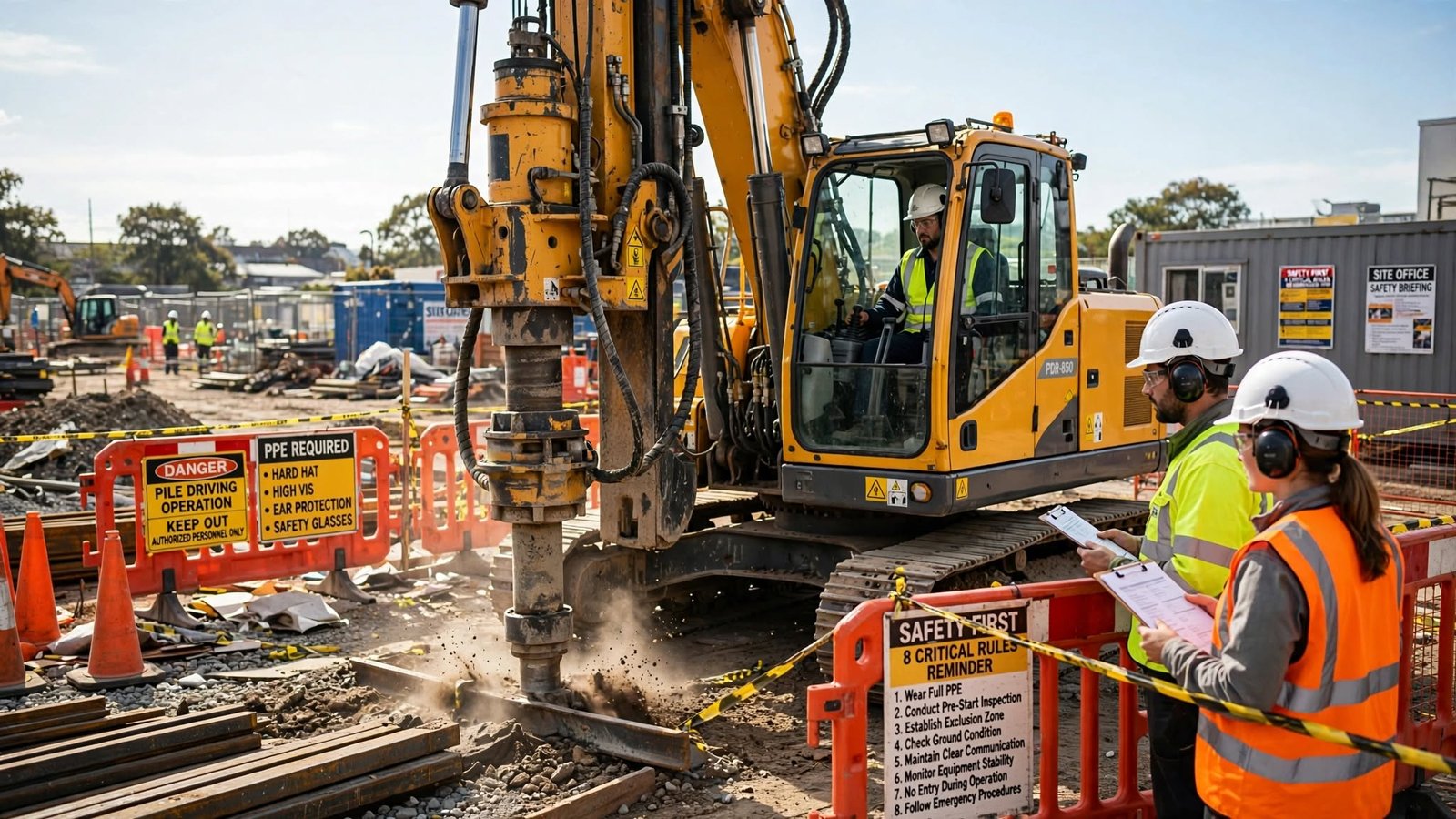
Pile Driving Safety Guide: 8 Critical Rules Every Operator Must Know

Table of Contents
- 1. Introduction
- 2. Install Hose Safety Chains on Every Connection
- 3. Use a Blocking Device Under the Hammer
- 4. Install Head-Block Sheave Guards
- 5. Install Two Shutoff Valves
- 6. Check Lead Stability Before Every Shift
- 7. Inspect Rigging and Retaining Bolts
- 8. Maintain a Clear Fall Zone
- 9. Follow Personal Protective Equipment Requirements
- 10. Wrapping It Up
- 11. Our Business Partners
1. Introduction
Every Pile Driving Safety Guide starts with the same truth: this work can kill you. Heavy loads suspended overhead. High-pressure hydraulic systems. Massive weights dropping repeatedly. One mistake can injure or kill someone.
Yet safety often gets treated as an afterthought on many job sites. The crew focuses on production. Getting piles driven. Meeting the schedule. Safety checks get rushed or skipped entirely, defying the rules of a proper Pile Driving Safety Guide.
OSHA has specific requirements for pile driving operations that must be followed to maintain a safe workplace. There are four devices written directly into 1926.603, and each one must be verified before driving begins. These are the items an inspector checks first—and the ones that prevent fatalities. A good Pile Driving Safety Guide highlights these facts.
Beyond meeting regulatory requirements, following safety rules protects the crew and keeps the job running. A serious accident stops production for days. Investigations take time. Equipment gets impounded. The whole project grinds to a halt.
This Pile Driving Safety Guide covers eight critical rules every operator must know and follow on every job. Some are obvious. Others get overlooked until something goes wrong. All of them save lives and prevent injuries.
2. Install Hose Safety Chains on Every Connection
A hose safety chain or equivalent is required on each hose connection to prevent the line thrashing if a coupling disconnects. This applies to steam, air, and hydraulic hoses including at the power pack. It is the first rule in this Pile Driving Safety Guide.
Hydraulic lines carry fluid at extremely high pressure. A burst hose whips around violently when it breaks. That whip can strike someone and cause serious injury. A chain keeps the hose contained if it breaks.
The chain should be at least ¼-inch and rated around 3,250 pounds. Never shorten the chain with knots or bolts—that weakens it. Every Pile Driving Safety Guide emphasizes this rating.
OSHA has confirmed this provision applies broadly to “each hose connection,” including hydraulic hammers and the power pack, not just steam lines. A securely tethered hose is the difference between a disconnected coupling being a nuisance and being fatal.
Check every hose connection before starting work. Make sure the safety chain is in place and properly secured. Inspect chains regularly for wear or damage. Replace any chain that shows signs of weakening.
Some crews try to save time by skipping this check. That is a mistake. A hose whipping under pressure can kill someone in an instant. Take the two minutes to verify every chain, as required by the Pile Driving Safety Guide.
The chain must be long enough to allow movement but short enough to contain the hose if it breaks. Too much slack defeats the purpose. Too little slack restricts movement and causes wear.
When replacing chains, use the correct rating. A chain that is too weak will break under pressure. A chain that is too strong might not flex properly. Match the chain to the hose and the pressure.
3. Use a Blocking Device Under the Hammer
A blocking device capable of safely supporting the hammer’s weight must be placed in the leads under the hammer at all times while employees work beneath it. This is what stops a suspended hammer from becoming a falling one.
The hammer weighs thousands of pounds. If the hydraulic system fails or a cable breaks, that weight comes down fast. A blocking device catches the hammer and prevents it from falling. This step is critical in the Pile Driving Safety Guide.
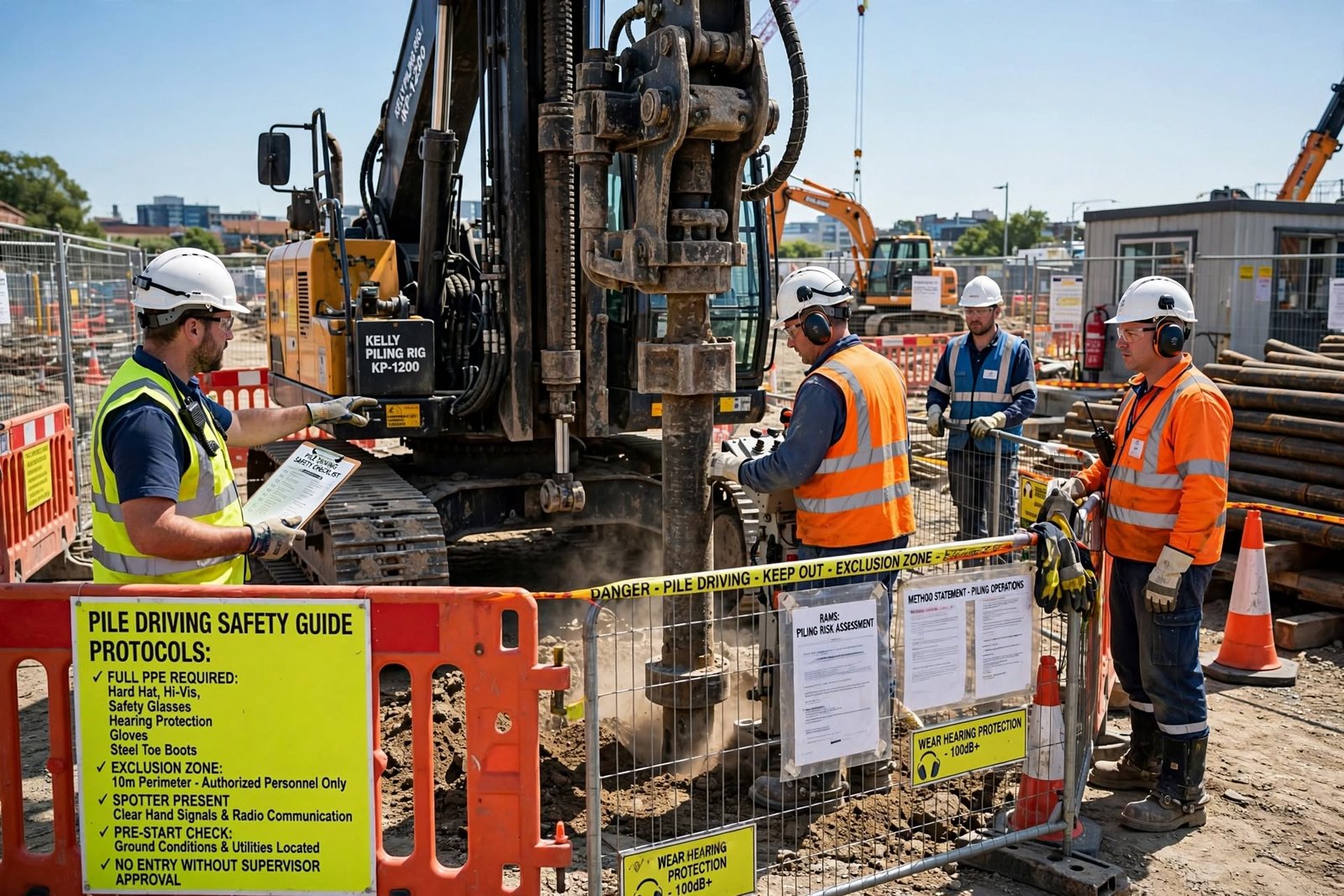
Never work under a suspended hammer without the blocking device in place. This rule applies any time someone needs to work beneath the hammer. No exceptions.
The blocking device must be rated for the hammer’s full weight. Do not improvise with makeshift blocks. Use the proper equipment. Test the blocking device before trusting it.
Workers often try to save time by not installing the blocking device for quick adjustments. This is how accidents happen. Install the blocking device every single time according to the Pile Driving Safety Guide.
The blocking device should be inspected regularly. Cracks, bends, or wear mean it needs replacement. A damaged blocking device is almost as dangerous as none at all.
4. Install Head-Block Sheave Guards
Guards are required across the top of the head block to prevent the hoist cable from jumping out of the sheaves under load. A derailed cable can drop the hammer or the pile.
The hoist cable runs over the sheave at the top of the leads. If the cable jumps out, the hammer loses support and falls. Guards keep the cable in place, an essential part of the Pile Driving Safety Guide.
Inspect the sheave guards regularly. Make sure they are securely attached. Replace damaged guards before they fail.
Sheave guards are often overlooked during routine inspections. Make them part of the daily checklist. A missing or damaged guard is a serious hazard.
The guards should be made of sturdy material. Thin metal bends easily. Weak guards fail when the cable jumps. Use guards that can handle the force, as recommended by this Pile Driving Safety Guide.
Check the guards after any cable change. New cables might be slightly different in diameter. The guards need to fit properly for them to work.
5. Install Two Shutoff Valves
Steam and compressed-air line controls require two shutoff valves, at least one a quick-acting lever type within easy reach of the hammer operator. This allows the energy source to be killed instantly.
If something goes wrong, the operator needs to shut off power immediately. One valve provides a backup in case the other fails. Quick-acting valves allow instant shutoff, a major requirement in any Pile Driving Safety Guide.
Test the shutoff valves before starting work. Make sure they work properly and are within reach of the operator. Label them clearly so anyone can find them in an emergency.
In an emergency, seconds matter. A stuck valve can mean the difference between a close call and a fatality.
The valves should be tested weekly. Sticking valves need repair or replacement. A valve that works today might not work tomorrow. Regular testing prevents surprises. The Pile Driving Safety Guide insists on constant testing.
6. Check Lead Stability Before Every Shift
Guys, outriggers, thrustouts, or counterbalances must be provided as needed to keep the rig stable. When leads are inclined to drive batter piles, provisions must stabilize them.
Unstable leads cause piles to go in crooked. Crooked piles fail under load. More importantly, unstable leads can tip the entire rig over. That causes serious injuries. Ensure you follow your Pile Driving Safety Guide regarding stability.
Check lead stability before every shift and periodically during use. Verify that all stabilizing equipment is properly deployed. If the rig starts to settle or shift, stop work immediately and correct the problem.
The ground changes throughout the day. Rain softens the soil. Equipment vibrations cause settling. What was stable in the morning might not be stable in the afternoon.
Outriggers need to be fully extended and locked. Partial extension can cause tipping. Check the locking mechanisms before every shift.
Batter piles put extra stress on the leads. The side load can cause instability. Extra precautions are needed when driving batter piles. This is a core focus in the Pile Driving Safety Guide.
7. Inspect Rigging and Retaining Bolts
Couplings, support and lifting equipment, rigging, and retaining bolts must be inspected before each shift and periodically during use. Hoist hooks need a means to prevent accidental disengagement, or use a shackle.
Rigging holds the hammer, piles, and other equipment. If rigging fails, heavy loads fall. Retaining bolts hold the leads together. If bolts loosen, the leads can collapse. Refer to the Pile Driving Safety Guide for inspection details.
Develop a checklist for rigging inspections. Look for wear, cracks, and loose components. Replace damaged rigging immediately. Do not try to patch or repair it.
Frayed cables, bent hooks, and loose bolts are warning signs. Ignoring them leads to failure. A rigging failure drops a load and injures someone.
Hoist hooks must have safety latches. Latches prevent the load from slipping off the hook. A missing latch is a serious hazard. Do not use a hook without a latch. Safety latch rules are critical in any Pile Driving Safety Guide.
Retaining bolts should be torqued to the proper specification. Overtightening damages the threads. Undertightening allows movement. Use a torque wrench for accuracy.
8. Maintain a Clear Fall Zone
No worker should ever be under the hammer or pile. Essential crew stays to the sides or rear of the leads. The Pile Driving Safety Guide mandates strict fall zones.
Falling objects are one of the leading causes of death on construction sites. A dropped hammer or pile weighs thousands of pounds. Nothing protects a person under that weight.
Mark the fall zone clearly. Use barriers or tape to keep people out. Enforce the rule strictly. No exceptions. No excuses.
Operators should sound a warning before starting each blow. The crew needs to know a load is about to drop. Clear communication prevents accidents.
The fall zone changes as the rig moves. Update the barriers each time the rig repositions. A barrier that does not match the current layout is useless. Follow your Pile Driving Safety Guide to adjust barriers.
Visitors to the site must stay out of the fall zone. Escort them around the work area. Do not let them wander near the equipment.
9. Follow Personal Protective Equipment Requirements
All workers on a pile driving site must wear proper PPE. Hard hats. Steel-toe boots. Hearing protection. High-visibility vests. A Pile Driving Safety Guide requires these essentials.
Pile driving is loud. Hearing damage happens gradually but permanently. Use proper ear protection.
Eye protection is essential. Debris flies around during driving. Dust gets in the air. Safety glasses or goggles protect the eyes.
Gloves protect hands from sharp edges and hot surfaces. Heavy-duty gloves are recommended for handling piles and cables.
No one should be on site without proper PPE. The operator has the authority to stop work if someone is not properly protected, a key empowerment in the Pile Driving Safety Guide.
PPE needs to be in good condition. Worn hard hats do not protect as well. Cracked safety glasses are useless. Replace damaged PPE immediately.
10. Wrapping It Up
Safety on a pile driving job comes down to following the rules. Every time. No exceptions.
The four devices OSHA requires—hose safety chains, blocking devices, sheave guards, and two shutoff valves—are not optional. They save lives. Check them before every shift.
Lead stability prevents tip-overs. Rigging inspections prevent dropped loads. Clear fall zones keep people out of danger. PPE protects against injuries. This Pile Driving Safety Guide outlines it all. To further protect your site, make sure you also read the pile driving maintenance guide 7 habits to keep your machines running safely.
Take safety seriously. It is not about compliance. It is about protecting the crew. A safe job is a productive job.
Looking to round out your jobsite fleet? Beyond deep foundation work, many crews also need lifting and access equipment on the same site.
Explore the powerful TYPHON Terror XVII Pro Prestige Edition Enclosed Mini Excavator with AC/Heater & Ergonomic Comfort for safe, efficient operations alongside your foundation crew.
11. Our Business Partners
For more details on heavy machinery and to see our business partners at work, check out the video below: