
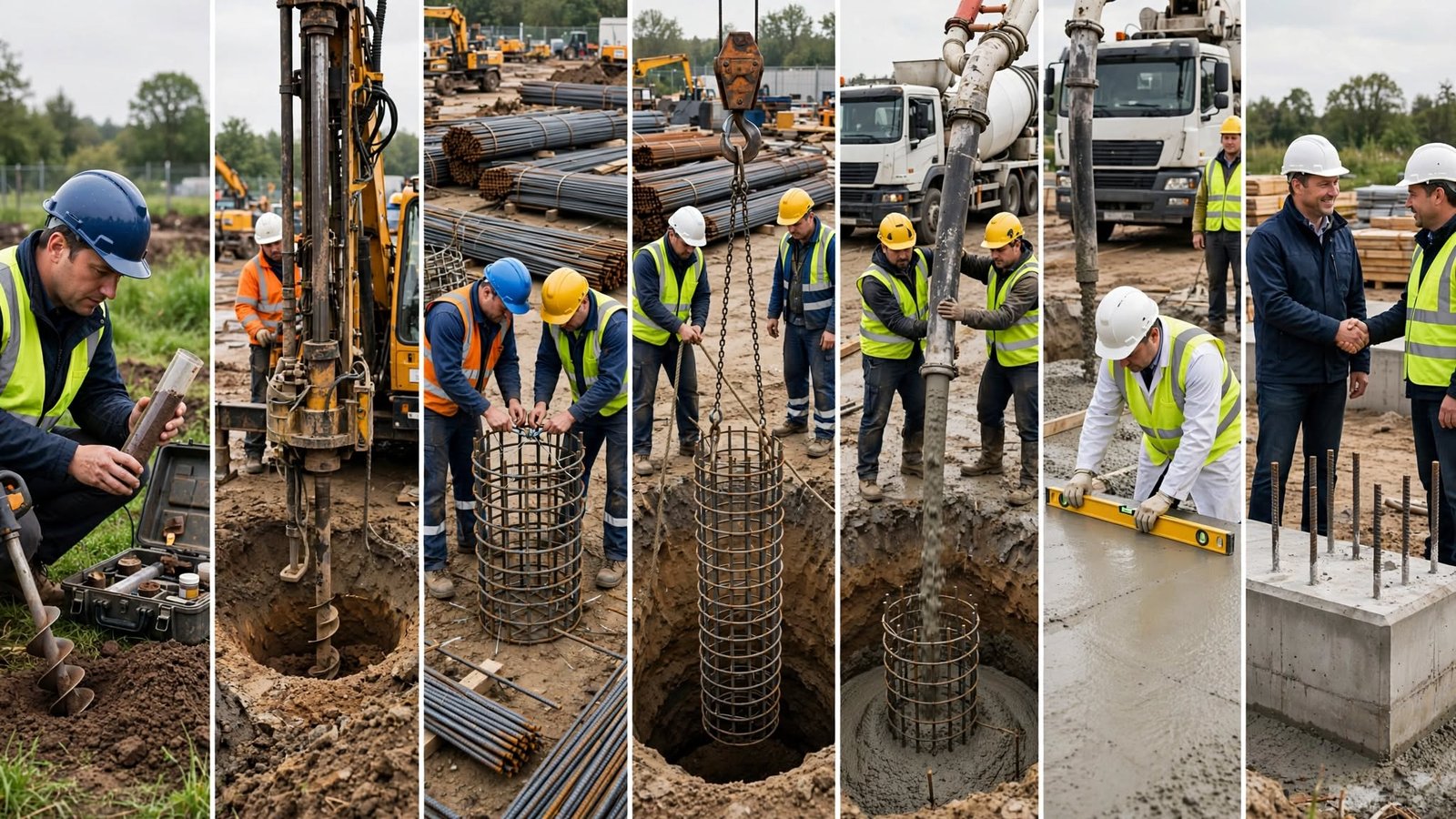
Pile Foundation Guide: 7 Steps to Build a Foundation That Lasts

Table of Contents
- 1. Introduction
- 2. Understand the Load the Foundation Must Carry
- 3. Investigate the Soil Before Designing the Foundation
- 4. Choose the Right Pile Type
- 5. Select Equipment That Matches the Job
- 6. Install the Piles with Precision
- 7. Verify Bearing Capacity Before Moving On
- 8. Protect the Foundation for the Long Term
- 9. Wrapping It Up
- 10. Our Business Partners
1. Introduction
Every Pile Foundation Guide should start with one fact. The foundation decides whether the structure stands or fails. Everything above it depends on what happens below the ground. Get the foundation right and the building lasts for decades. Get it wrong and no amount of concrete above will save it.
Pile foundations go deep. They reach past weak soil to stronger layers below. They carry the weight of everything above. They resist wind, earthquakes, and water. They do all of this while buried underground where no one can see them.
That is why pile foundation work is unforgiving. Mistakes do not show up right away. They show up years later when the structure settles or cracks. By then it is too late, a stark reality covered in this Pile Foundation Guide.
This Pile Foundation Guide covers seven steps that lead to a foundation that lasts. Each step builds on the one before. Skip a step and the whole thing suffers.
2. Understand the Load the Foundation Must Carry
Every pile foundation starts with a question. How much weight does the structure put on the ground? The answer decides everything else, laying the groundwork for a solid Pile Foundation Guide.
A small warehouse carries different loads than a high-rise tower. A bridge carries different loads than a house. The pile foundation must match the structure it supports.
Dead load is the weight of the structure itself. Concrete, steel, roofing, walls. All of it adds up. The pile foundation must carry this weight forever.
Live load is the weight of things that move. People, furniture, vehicles, equipment. Live loads change but they still push down on the foundation.
Environmental loads come from outside. Wind pushes sideways. Earthquakes shake. Water rises. The pile foundation must resist these forces too.
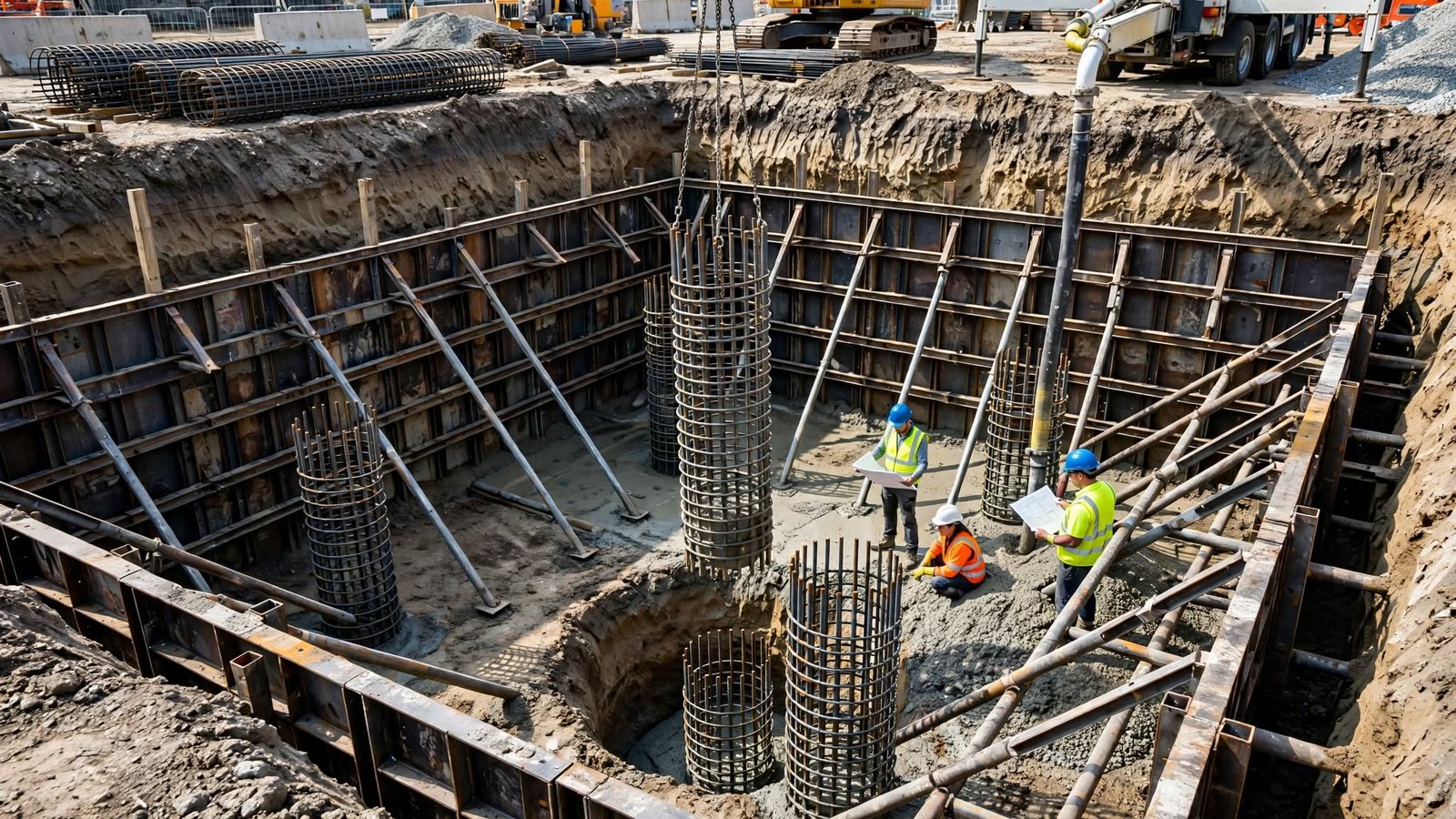
Understanding the loads requires engineering. A structural engineer calculates the total load. That number goes into the foundation design. Guessing at loads leads to undersized piles. Undersized piles fail.
The load also decides the pile size. Heavier loads need larger piles. More piles. Deeper piles. The pile foundation scales to the structure.
This step happens before any equipment arrives. It happens on paper. But it decides everything that follows. Get the loads right and the foundation has a chance. Get them wrong and nothing else matters.
3. Investigate the Soil Before Designing the Foundation
Soil is the other half of the pile foundation equation. The best-designed piles fail in bad soil. Knowing what is underground prevents surprises, a critical rule in this Pile Foundation Guide.
Every site has different soil. Sand, clay, silt, gravel, rock. Each behaves differently under load. Each requires different pile foundation methods.
A geotechnical engineer investigates the soil. Test holes get drilled. Samples get analyzed. The report shows what is down there.
Bearing capacity is the key number. It tells how much load the soil can carry. The pile foundation must transfer the structure load to soil with enough bearing capacity.
Water table depth matters too. High water tables cause problems. They soften soil and reduce friction. They corrode piles. The pile foundation must account for groundwater.
Problem layers cause delays and failures. Soft pockets. Boulders. Old fill material. The investigation finds these before construction starts.
The soil investigation costs money. But it prevents bigger costs later. A pile foundation built on assumptions is a foundation waiting to fail.
Test multiple locations. Soil changes across a site. One test hole is not enough. A grid of holes provides a complete picture. The pile foundation design depends on this data in your Pile Foundation Guide.
Review the report with the entire team. The engineer. The contractor. The foreman. Everyone should know what to expect underground.
4. Choose the Right Pile Type
Not all piles are the same. Different materials. Different shapes. Different installation methods. The right choice depends on the soil and the loads, a key choice outlined in the Pile Foundation Guide.
Steel piles are strong. They handle high energy. They drive through hard layers. They work in almost any soil. Steel piles last a long time when protected from corrosion.
Concrete piles are common. They are cheaper than steel. They work well in many conditions. But they crack under high energy. They need careful handling during driving.
Timber piles are the oldest type. They are cheap and simple. They work in soft soil. But they have limited length and limited life. They rot above the water table.
Composite piles combine materials. Steel cores with concrete shells. Fiber reinforced polymers. These work in special conditions. They cost more but solve specific problems.
The pile type affects the equipment. Steel piles need impact hammers. Concrete piles need softer blows. Timber piles need light hammers. Following a solid Pile Foundation Guide makes this easier.
The pile type also affects the schedule. Steel drives fast. Concrete takes longer. Timber is quick in soft soil.
Choose the pile type during the design phase. Match it to the soil and the loads. Match it to the equipment available. Match it to the budget. The wrong pile type causes problems throughout the pile foundation job.
5. Select Equipment That Matches the Job
Equipment selection follows pile selection. The hammer must match the pile. The rig must match the hammer. The whole system must work together.
Impact hammers drive steel piles. They deliver high energy. They work in hard soil. They prove bearing capacity by blow count.
Vibratory hammers drive sheet piles. They work in sand and gravel. They are quiet and fast. They cannot prove bearing capacity.
Rotary rigs drill holes for cast-in-place piles. They work in rock and mixed soil. They are quiet and vibration free. They take longer than driving.
The rig must support the hammer. It must position the leads. It must move around the site. The rig size matches the pile length and weight.
The equipment must match the site. Urban sites need quiet equipment. Remote sites need self-contained equipment. Tight sites need compact equipment. The Pile Foundation Guide recommends checking site constraints early.
Maintenance matters too. Well-maintained equipment runs longer. It breaks down less. It drives more piles per shift. The pile foundation schedule depends on uptime.
Spare parts prevent delays. Cushions. Hoses. Cables. Having spares on site means quick repairs. Waiting for parts costs days.
Equipment selection is not just about the hammer. It is about the whole system. The pile foundation job requires equipment that works together. This is a core focus of the Pile Foundation Guide.
6. Install the Piles with Precision
Installation is where the pile foundation becomes real. Everything up to this point has been planning. Now the piles go in the ground.
Alignment comes first. The leads must be plumb. The helmet must be centered. The pile must go in straight. Crooked piles fail under load. They stress the structure. They fail inspection. Precision is critical in this Pile Foundation Guide.
The first blows set the direction. Start slow. Let the pile seat itself. Watch for drift. Correct it immediately. A pile that starts straight stays straight. A pile that starts crooked stays crooked.
Monitor blow count throughout. Rising blow count means denser soil. Falling blow count means softer soil. Erratic blow count means problems. Stop and investigate.
Watch the set near the end. Set is how far the pile moves per blow. When set drops to the target, the pile has reached bearing. Stop driving. Overdriving damages piles.
Record everything. Blow counts. Set measurements. Pile locations. Depth. All of it goes into the record. The pile foundation job depends on this documentation.
Inspect piles before and after driving. Look for cracks or damage. Do not drive damaged piles. Replace them. A comprehensive Pile Foundation Guide details these checks.
Installation precision decides whether the pile foundation lasts. A pile driven straight and driven to bearing carries its load. A pile driven crooked or underdriven fails.
7. Verify Bearing Capacity Before Moving On
Driving a pile is not the same as proving it works. Verification confirms the pile foundation meets the design.
Blow count and set provide one check. They show that the pile reached bearing. They do not prove the soil can carry the load.
Load tests provide better proof. A static load test pushes the pile and measures movement. The results show actual capacity. The pile foundation passes or fails based on data.
Dynamic testing measures the hammer blow and the pile response. Sensors on the pile record the energy. The data calculates capacity. Dynamic testing is faster and cheaper than static testing.
Some projects require load tests on every pile. Others test a percentage. The spec decides. Follow the spec for the pile foundation.
Document all test results. The inspector needs this data. The client needs this data. The pile foundation record depends on it. Any Pile Foundation Guide will insist on rigorous record-keeping.
If a pile fails verification, fix it. Drive a replacement pile nearby. Pre-drill and re-drive. Do not ignore the failure. A failed pile in the foundation causes problems later.
Verification is not optional. It is the proof that the pile foundation works.
8. Protect the Foundation for the Long Term
A pile foundation must last decades. Protection starts during installation and continues after.
Corrosion protection for steel piles. Coatings. Cathodic protection. Thicker steel. Corrosion eats steel over time. Protection slows it down.
Concrete piles need proper curing. They need adequate cover over reinforcement. They need protection from sulfate attack and chloride.
Timber piles need protection above the water table. Creosote treatments. Plastic wraps. Without protection, timber rots.
The pile caps and connections need attention. They connect the piles to the structure. Corrosion there weakens the whole pile foundation. It is an often-forgotten part of the Pile Foundation Guide.
Inspect the foundation after installation. Look for damage. Fix problems before the structure goes up.
Monitor the foundation over time. Settlement monitoring. Corrosion monitoring. Early detection prevents major failures.
Documentation helps long-term protection. Records show what was installed. They show what protection was applied. Future maintenance depends on these records.
The pile foundation must survive for the life of the structure. Protection ensures it does.
9. Wrapping It Up
A pile foundation that lasts starts with understanding. Understand the loads. Understand the soil. Choose the right pile. Choose the right equipment. Install with precision. Verify capacity. Protect for the long term.
This Pile Foundation Guide covers seven steps. Each one matters. Skipping any of them weakens the foundation. If you want to refine your workflow before starting, review pile driving planning 6 steps to avoid delays on site.
Foundations are invisible. No one sees them after construction. But they carry everything above. They must be right.
Do the work. Follow the steps. Build a pile foundation that lasts. Use this Pile Foundation Guide to secure success from the ground up.
Looking to round out your jobsite fleet? Beyond deep foundation work, many crews also need lifting and access equipment on the same site.
Explore the powerful TYPHON Terror IV ProPact Series 9000-lb Mini Excavator with Kubota D1703 3-Cylinder Diesel Engine for safe, efficient operations alongside your foundation crew.
10. Our Business Partners
For more details on heavy machinery and to see our business partners at work, check out the video below: